What Is the Highest Common Factor (HCF)?
The highest common factor of two numbers is the biggest whole number that divides both of them exactly. Take 36 and 60. The factors of 36 are 1, 2, 3, 4, 6, 9, 12, 18 and 36. The factors of 60 are 1, 2, 3, 4, 5, 6, 10, 12, 15, 20, 30 and 60. They share 1, 2, 3, 4, 6 and 12, and the biggest is 12. So HCF(36, 60) = 12.
HCF, GCF (greatest common factor) and GCD (greatest common divisor) are three names for the same number. HCF is the word used in the UK, India and many other countries, so if your book says HCF, this is the right page.
How to Use This HCF Calculator
- Enter two numbers in the First number and Second number boxes.
- Press Calculate, or hit Enter.
- You get the HCF, the LCM, the prime factorization of each number, the common factors and the division steps.
Method 1: HCF by the Division Method
This is the method most Indian and UK textbooks call the long division method, and it is the best choice when the numbers are big. Divide the larger number by the smaller one. Then divide the old divisor by the remainder. Repeat until the remainder is 0. The last divisor is the HCF.
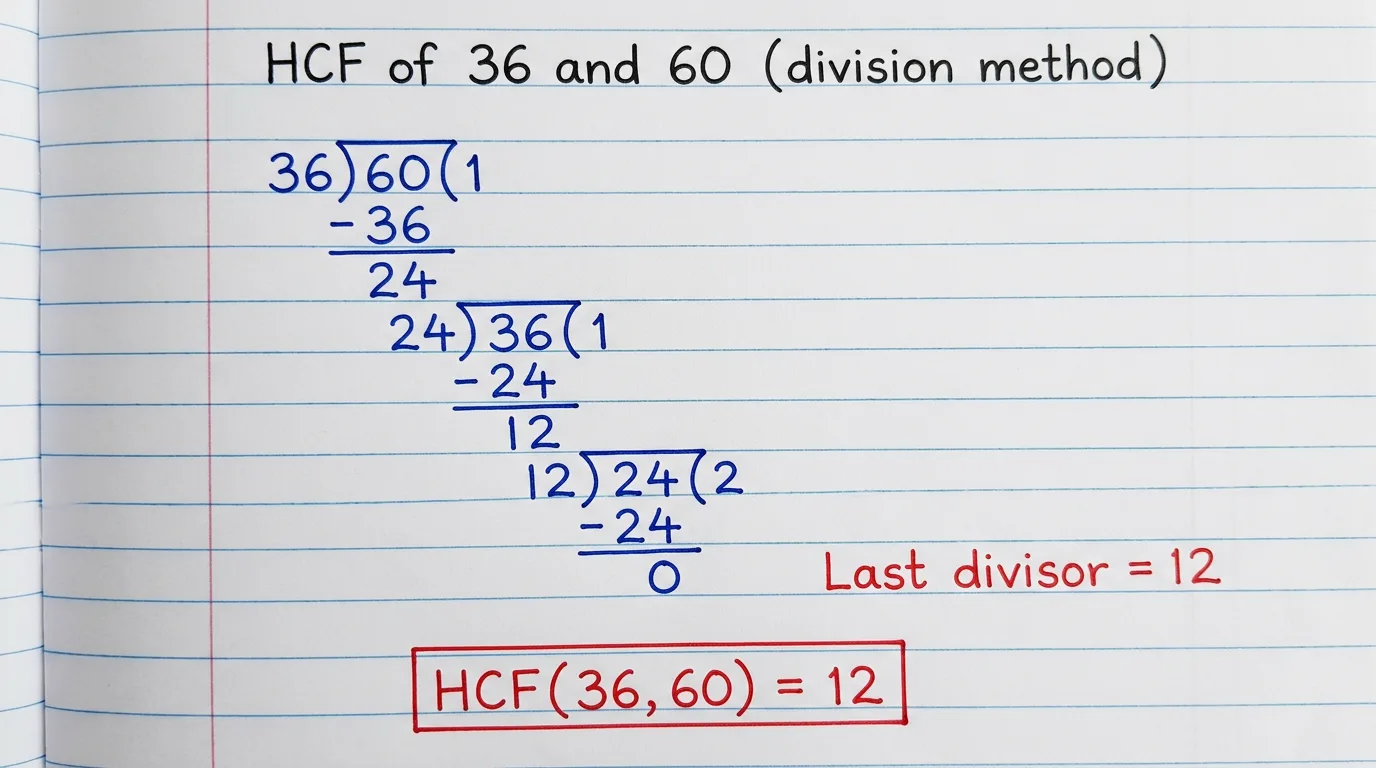
Why does it work? Anything that divides both numbers also divides the remainder, so the pair keeps the same common factors while the numbers shrink. When the remainder hits 0, the divisor you just used is what is left.
Method 2: HCF by Prime Factorization
Write each number as a product of primes. Pick the primes that appear in both, at their lowest power, and multiply them. For 36 and 60:
- 36 = 2² × 3²
- 60 = 2² × 3 × 5
The shared primes are 2 and 3. The lowest power of 2 is 2², and the lowest power of 3 is 3¹. So HCF = 2² × 3 = 4 × 3 = 12. The prime 5 only appears in 60, so it stays out.
Method 3: HCF by Listing Factors
For small numbers you can simply list the factors, as we did for 36 and 60 at the top of the page, and pick the biggest one in both lists. It is the easiest method to understand, and a good way to check the other two.
How to Find the HCF of Three Numbers
Find the HCF of two of the numbers, then find the HCF of that answer and the third number. Here it is for 12, 18 and 30:
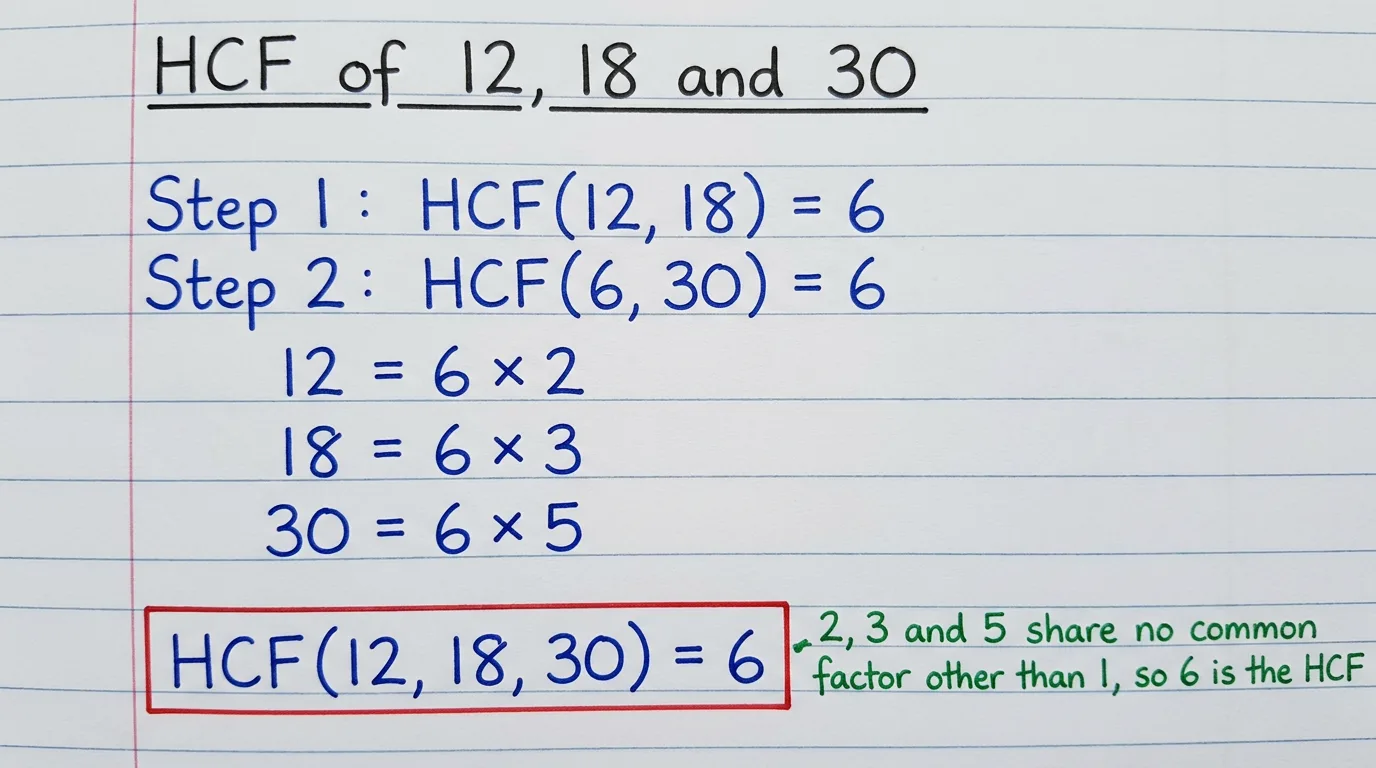
There is a nice way to check. Divide each number by your answer: 12 ÷ 6 = 2, 18 ÷ 6 = 3 and 30 ÷ 6 = 5. Those three results have no common factor except 1, so no bigger number could have worked.
The Link Between HCF and LCM
For any two numbers, the HCF and the LCM multiply to give the same result as the numbers themselves:
HCF × LCM = first number × second number
Check it with 36 and 60. The HCF is 12 and the LCM is 180, and 12 × 180 = 2,160, which is also 36 × 60. So if you know the HCF and one of the numbers, you can get the missing number too. This rule is only true for two numbers, not three.
HCF Word Problems
Any question that asks for the largest equal size, group or piece is an HCF question.
Cutting ropes
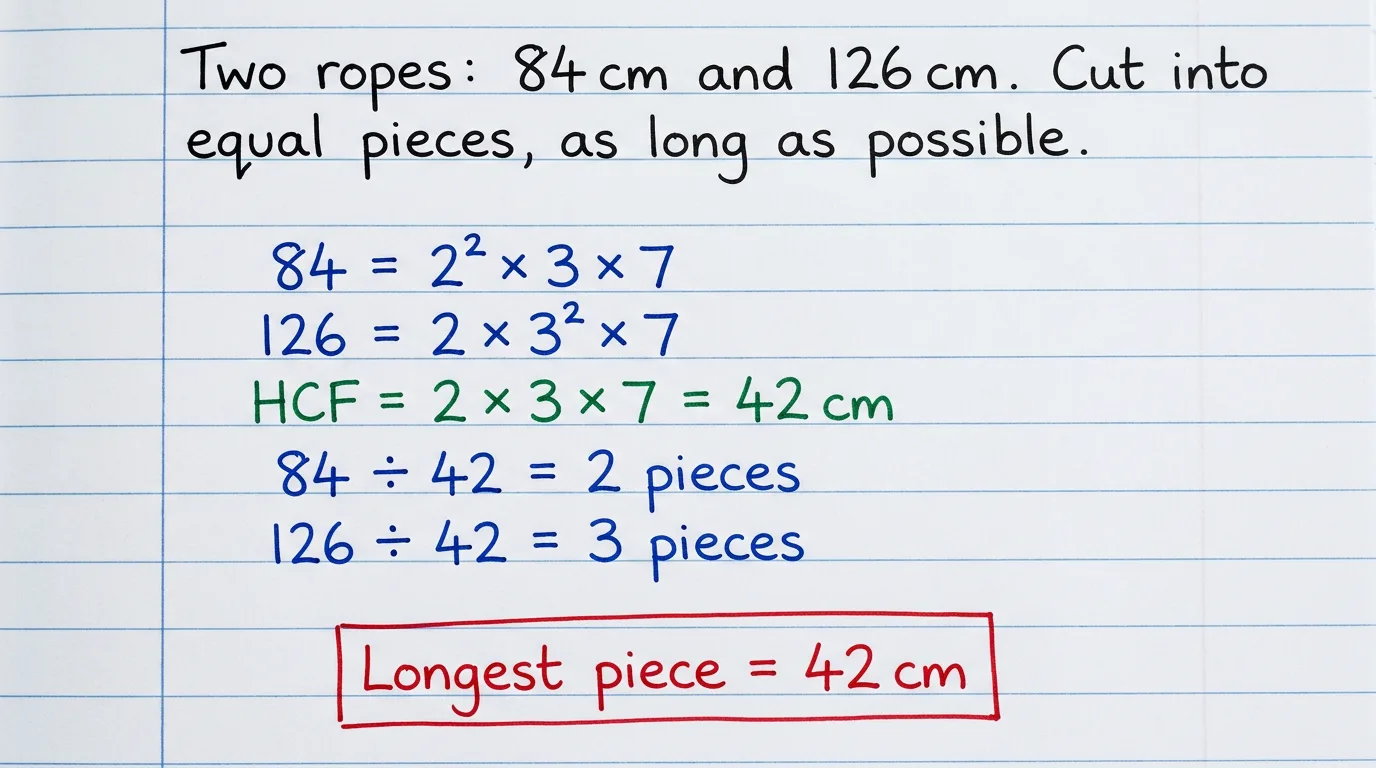
Two ropes are 84 cm and 126 cm long. They are cut into equal pieces that are as long as possible, with nothing left over. How long is each piece?
Packing boxes
A shop has 48 apples and 36 oranges and wants identical boxes with no fruit left over. HCF(48, 36) = 12, so it can fill at most 12 boxes. Each box gets 4 apples (48 ÷ 12) and 3 oranges (36 ÷ 12).
Simplifying a fraction
To reduce 84/126, divide the top and bottom by their HCF, which is 42. You get 84 ÷ 42 = 2 and 126 ÷ 42 = 3, so 84/126 = 2/3. One step, and it is in lowest terms.
HCF Shortcuts Worth Remembering
- Two prime numbers that are different always have an HCF of 1. HCF(13, 17) = 1.
- Consecutive numbers also have an HCF of 1. HCF(14, 15) = 1.
- If one number divides the other, the HCF is the smaller one. HCF(9, 27) = 9.
- The HCF is never bigger than the smaller of your numbers.
- If both numbers are even, the HCF is at least 2.
Common HCF Mistakes to Avoid
- Mixing up HCF and LCM. The HCF is small and divides into the numbers. The LCM is big and the numbers divide into it.
- Using the highest power. For the HCF use the lowest power of each shared prime.
- Taking a prime that is not in both. If it is missing from even one number, it stays out.
- Giving the remainder instead of the divisor. In the division method the answer is the last divisor, the one that leaves a remainder of 0.
Enter the same two numbers in the calculator above to check your answer.