What Is a Prime Number?
A prime number is a whole number greater than 1 with exactly two factors: 1 and itself. 7 is prime because only 1 and 7 divide it evenly. A composite number has more than two factors, so 8 is composite because 1, 2, 4 and 8 all divide it.
The number 1 is neither prime nor composite, because it has only one factor. And 2 is the only even prime.
How to Use This Prime Number Checker
- Type a whole number into the box. Use Paste if you have it copied.
- Press Check, or hit Enter.
- Read the yes or no answer, the division test behind it, and every factor of the number.
How to Check If a Number Is Prime
Divide the number by each prime, starting with 2, and only go as far as its square root. If any prime divides it with a remainder of 0, the number is composite. If none does, it is prime. Here is 97:
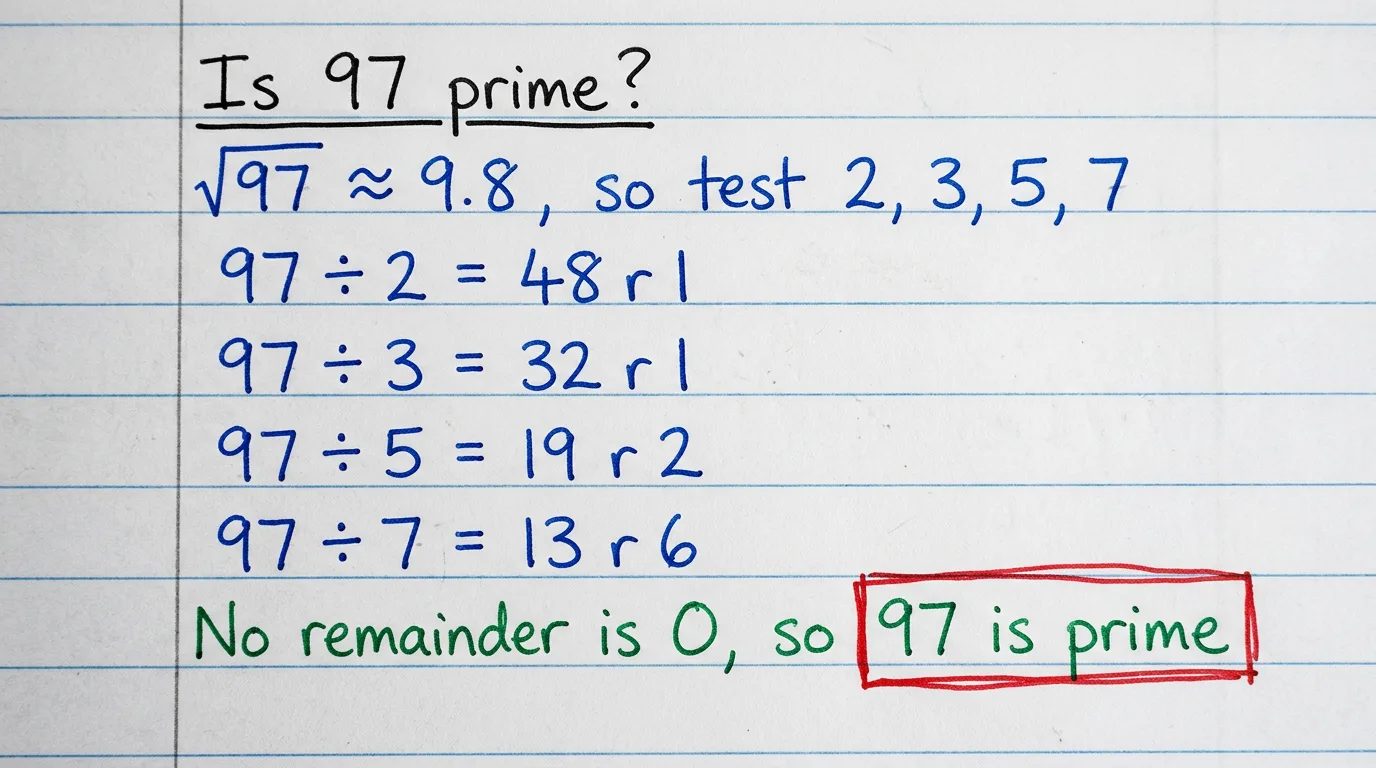
Why stop at the square root? If a number had a factor bigger than its square root, it would also have a partner factor smaller than it. So if no small prime divides it, no large one will either.
The Trap: Numbers That Look Prime
Some numbers pass the quick checks, because they are odd, do not end in 5 and are not obviously a multiple of 3, but still turn out composite. 91 is the classic one:
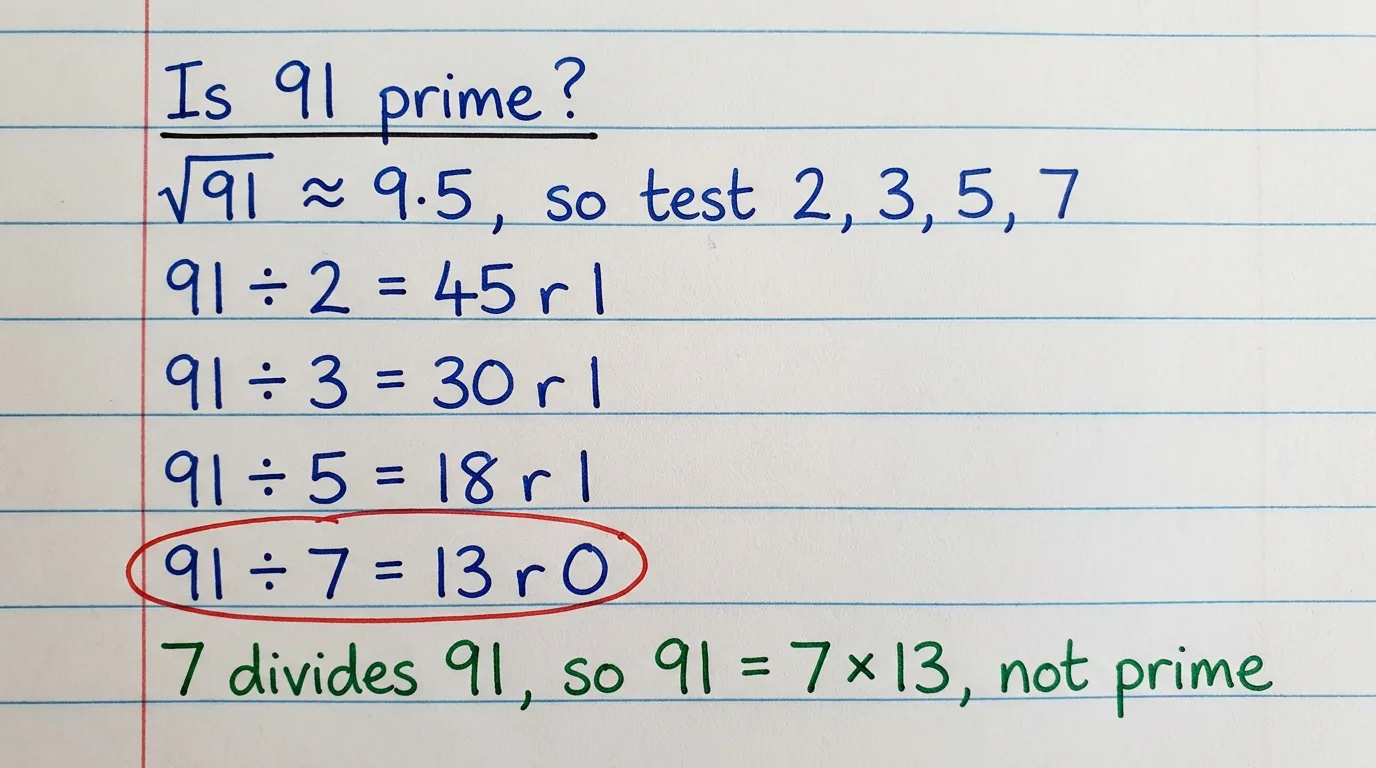
Other numbers that fool people: 51 = 3 × 17, 119 = 7 × 17 and 221 = 13 × 17. Always run the full test up to the square root.
Quick Divisibility Rules
- 2: the last digit is even.
- 3: the digits add up to a multiple of 3.
- 5: the number ends in 0 or 5.
- 11: alternately subtract and add the digits. If the result is 0 or a multiple of 11, then 11 divides the number.
Checking 2, 3 and 5 first removes about three quarters of all numbers in a second.
Prime Numbers up to 100
There are 25 primes below 100: 2, 3, 5, 7, 11, 13, 17, 19, 23, 29, 31, 37, 41, 43, 47, 53, 59, 61, 67, 71, 73, 79, 83, 89, 97.
Worked Examples
- Is 97 prime? Yes.
- Is 91 prime? No, 91 = 7 × 13.
- Is 221 prime? No, 221 = 13 × 17.
- Is 1,009 prime? Yes.
Common mistakes
- Calling 1 prime. It has only one factor, so it is not.
- Thinking all odd numbers are prime. 9, 15, 21 and 91 are odd and composite.
- Stopping the test too early. Test every prime up to the square root, not just 2, 3 and 5.