LCD Calculator

Enter two denominators to find the least common denominator, with the steps and equivalent fractions shown.

Examples:24, 3648, 18084, 12617, 31

LCD(48, 180) = 720

Prime factorizations

48 = 243

180 = 22325

LCD formula

(48 × 180) ÷ 12 = 8,640 ÷ 12 = 720

Equivalent fractions over 720

  • 1/48 = 15/720
  • 1/180 = 4/720

Multiply the top and bottom of each fraction by 720 ÷ its denominator.

What Is the Least Common Denominator?

The least common denominator (LCD) is the smallest number that two or more denominators all divide into evenly. It is the same number as the least common multiple (LCM) of those denominators, and you need it to add, subtract or compare fractions with different bottoms.

How to Use This LCD Calculator

  1. Type the first denominator into the first box.
  2. Type the second denominator into the second box.
  3. Press Calculate to see the LCD, the formula and the equivalent fractions.

How to Find the LCD

  1. Write each denominator as a product of primes.
  2. Take every prime that appears, at its highest power.
  3. Multiply them together. That product is the LCD.
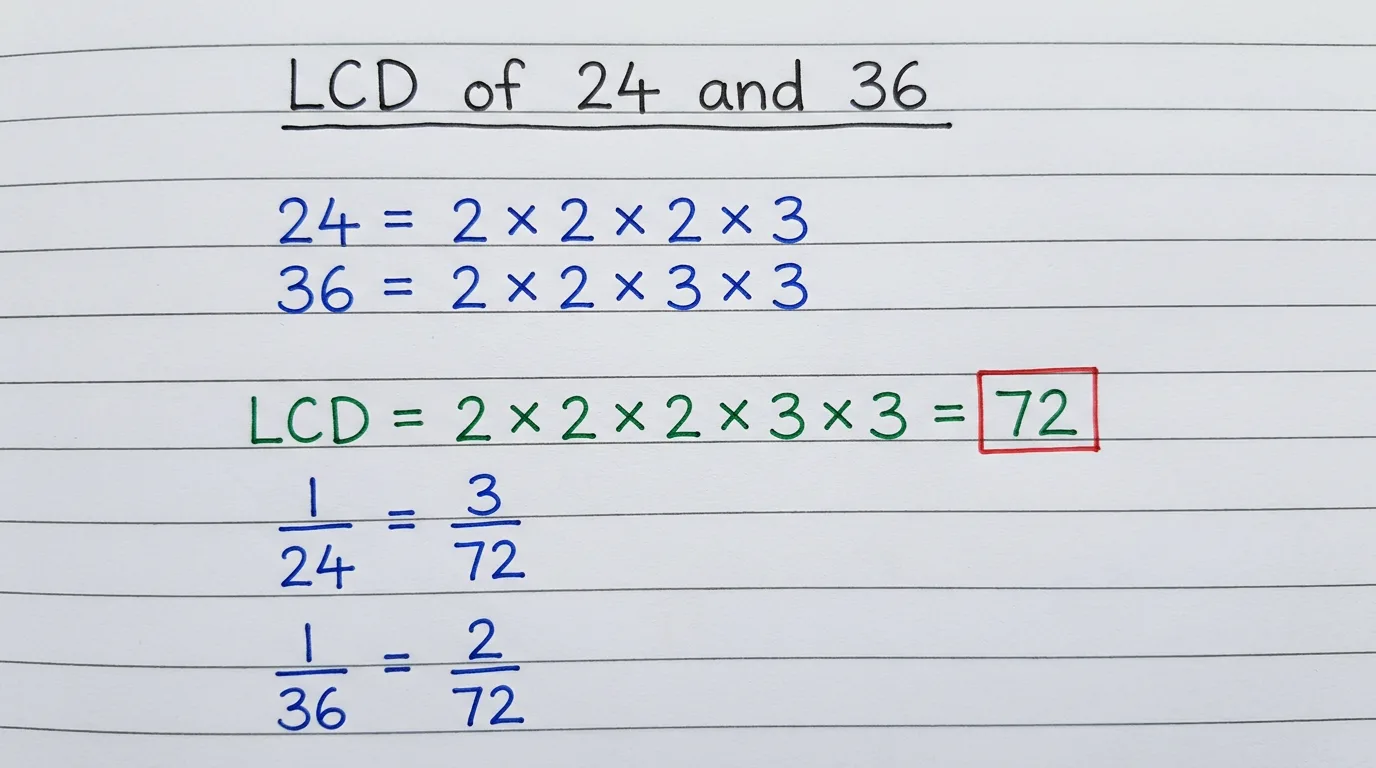
Handwritten notebook page finding the LCD of 24 and 36 as 72 with equivalent fractions 3/72 and 2/72
LCD(24, 36) = 2 × 2 × 2 × 3 × 3 = 72, so 1/24 = 3/72 and 1/36 = 2/72.

The Shortcut: Use the GCF

You can skip the prime factors. Multiply the two denominators and divide by their GCF: (24 × 36) ÷ 12 = 864 ÷ 12 = 72. When the denominators share no factor, the GCF is 1 and the LCD is just their product.
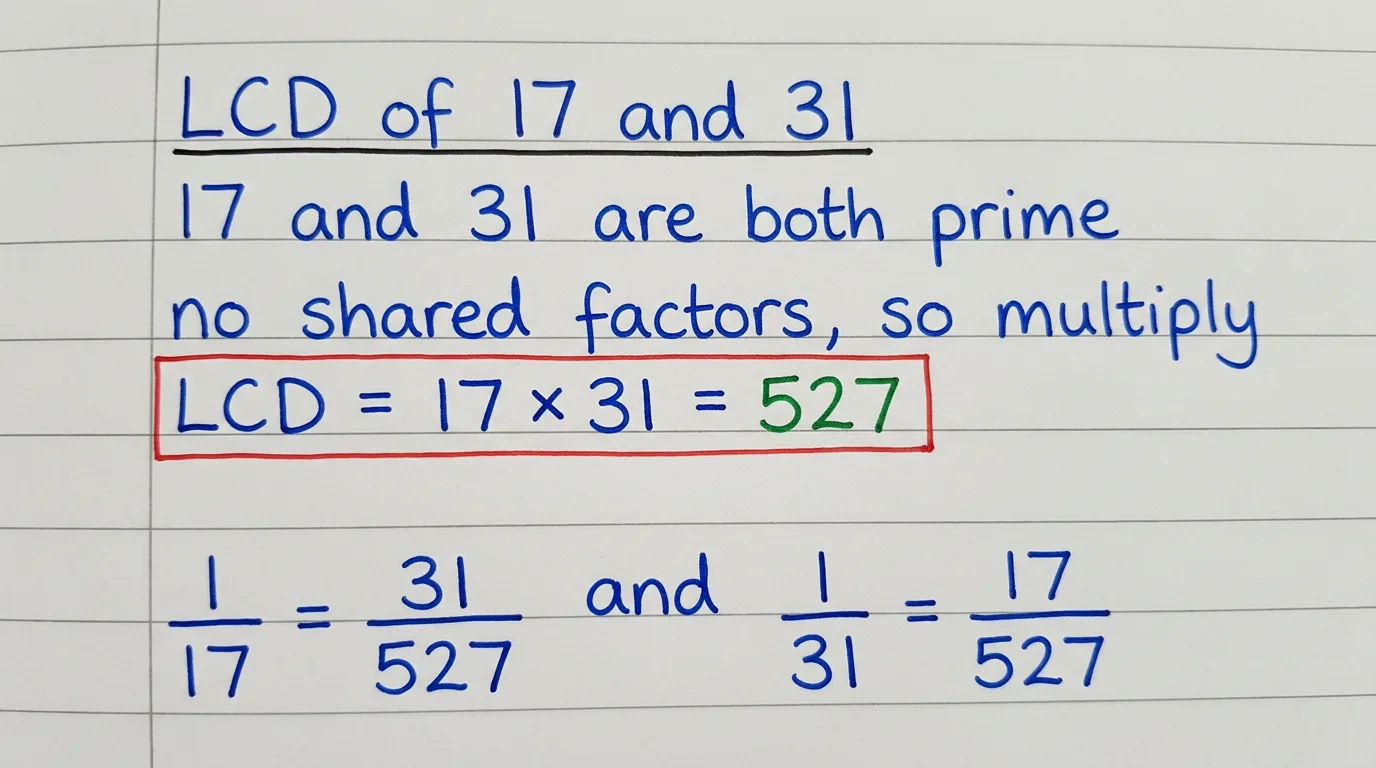
Handwritten notebook page showing the LCD of 17 and 31 is their product, 527, because both are prime
17 and 31 are both prime, so the LCD is 17 × 31 = 527.

Using the LCD to Add Fractions

Rewrite each fraction over the LCD, then add the numerators. For 1/24 + 1/36, the LCD is 72, so 1/24 = 3/72 and 1/36 = 2/72, and the sum is 5/72.

Worked Examples

Common mistakes

LCD Calculator FAQs

What is the least common denominator?

The least common denominator (LCD) is the smallest number that all the denominators divide into evenly. It is the least common multiple (LCM) of the denominators.

How do you find the LCD of two fractions?

Find the LCM of the two denominators. Multiply them and divide by their GCF, or take every prime at its highest power. For denominators 24 and 36 the LCD is 72.

Is the LCD the same as the LCM?

Yes. The LCD is just the LCM applied to the denominators of fractions. The calculation is identical.

Why do I need a common denominator?

You can only add, subtract or compare fractions when their denominators match, because the pieces must be the same size. The LCD is the smallest size that works for all of them.

What is the LCD of 48 and 180?

720. 48 = 2⁴ × 3 and 180 = 2² × 3² × 5, so the highest powers give 2⁴ × 3² × 5 = 720.

What if the denominators share no factors?

If the GCF is 1, the denominators are coprime and the LCD is simply their product. The LCD of 17 and 31 is 17 × 31 = 527.

How do I add fractions using the LCD?

Rewrite each fraction over the LCD by multiplying its top and bottom by the same number, then add the numerators and keep the denominator.

Can I use any common denominator instead of the least one?

Yes, any common multiple works, but the least one keeps the numbers small and usually leaves less to simplify at the end.