What Is a Perfect Square?
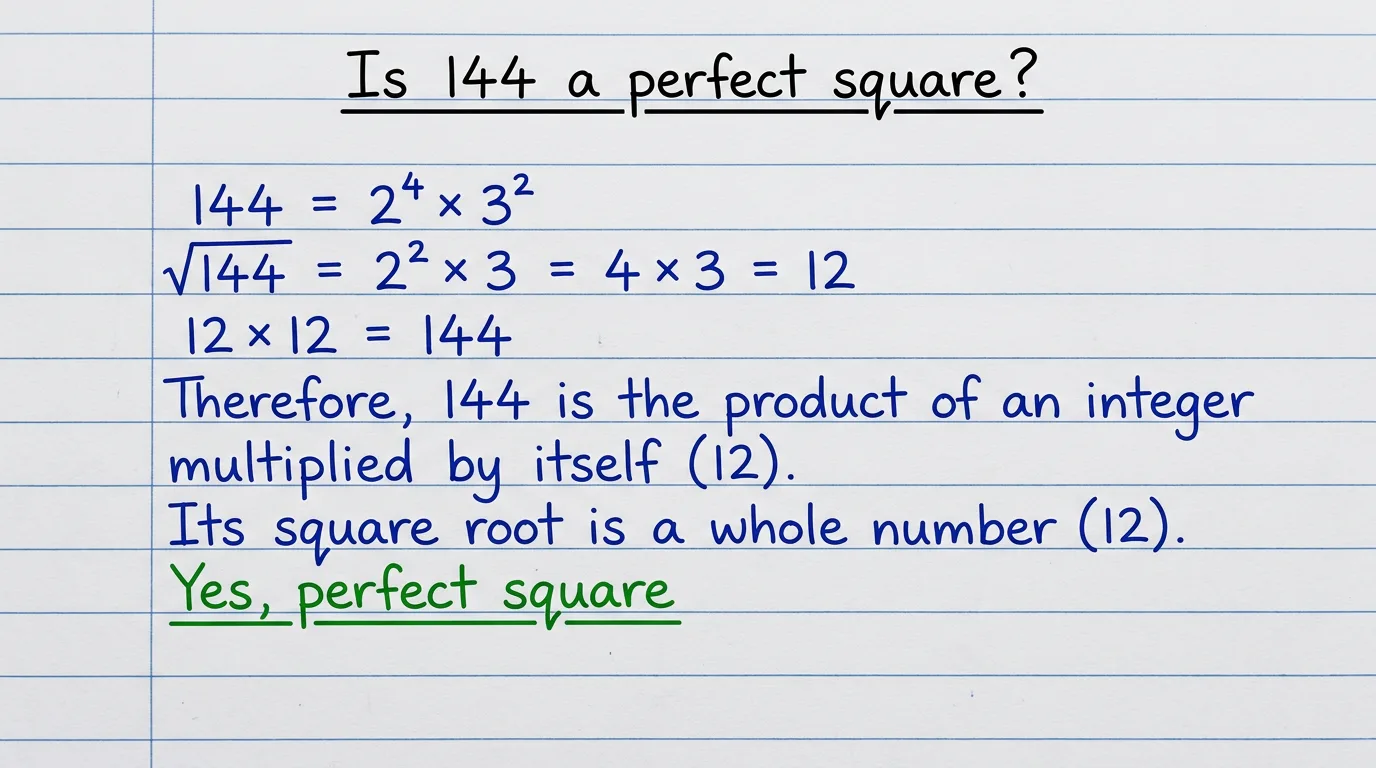
A perfect square is a whole number that equals another whole number multiplied by itself. 144 is a perfect square because 12 × 12 = 144. The numbers 1, 4, 9, 16, 25 and 36 are the first few.
How to Use This Perfect Square Calculator
- Type any whole number into the box.
- Press Calculate to see whether it is a perfect square, its square root, its prime factorization and its simplest radical form.
How to Check if a Number Is a Perfect Square
- Find the square root of the number.
- If the square root is a whole number, the number is a perfect square.
- Or write the number as a product of primes. If every exponent is even, it is a perfect square.
Simplest Radical Form
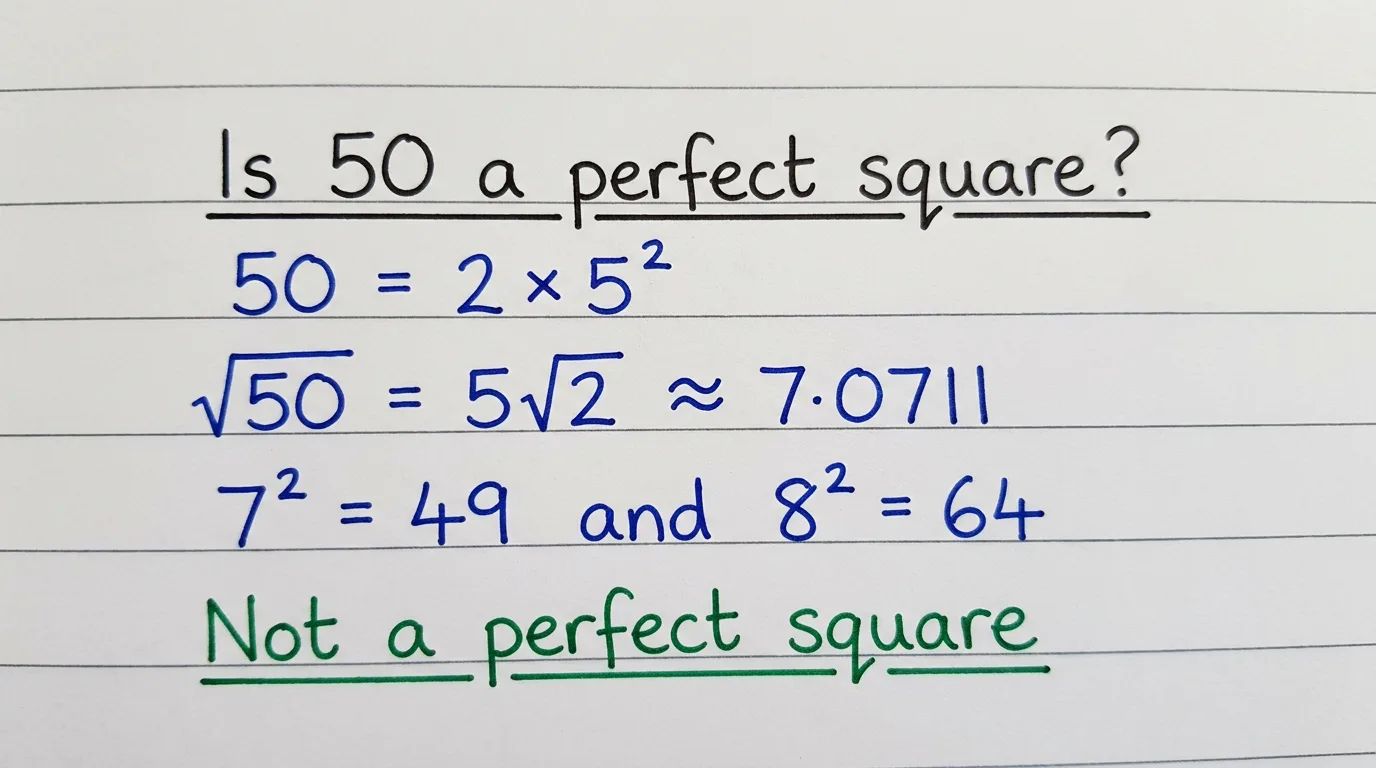
When a number is not a perfect square, you can still pull its square factors out of the root. 50 = 2 × 5², so √50 = 5√2.
Worked Examples
- Is 144 a perfect square? Yes, 12 × 12
- Is 50 a perfect square? No, √50 = 5√2
- Is 1,225 a perfect square? Yes, 35 × 35
- Is 1,000 a perfect square? No, √1000 = 10√10
Common mistakes
- Judging by the last digit alone. A square ends in 0, 1, 4, 5, 6 or 9, but many non-squares end in those digits too.
- Rounding the root. A root like 7.0711 is not a whole number, so 50 is not a perfect square.
- Missing an odd exponent. One odd exponent in the prime factorization is enough to rule a number out.