What Is the Least Common Multiple (LCM)?
The least common multiple of two numbers is the smallest number that both of them divide into exactly. Take 4 and 6. The multiples of 4 are 4, 8, 12, 16 and so on. The multiples of 6 are 6, 12, 18 and so on. The first number that shows up in both lists is 12, so LCM(4, 6) = 12.
Do not mix it up with the GCF. The GCF is a factor, so it is small. The LCM is a multiple, so it is big. The LCM is never smaller than the larger of your two numbers.
How to Use This LCM Calculator
- Type your two numbers into the First number and Second number boxes.
- Press Calculate, or hit Enter.
- You get the LCM together with the GCF, both prime factorizations and the working, so you can copy the steps into your homework.
The example pairs under the box are a quick way to see a finished answer before you try your own numbers.
Method 1: Find the LCM by Listing Multiples
Write out the multiples of each number until one of them appears in both lists. That first match is the LCM. Here is 6 and 8:
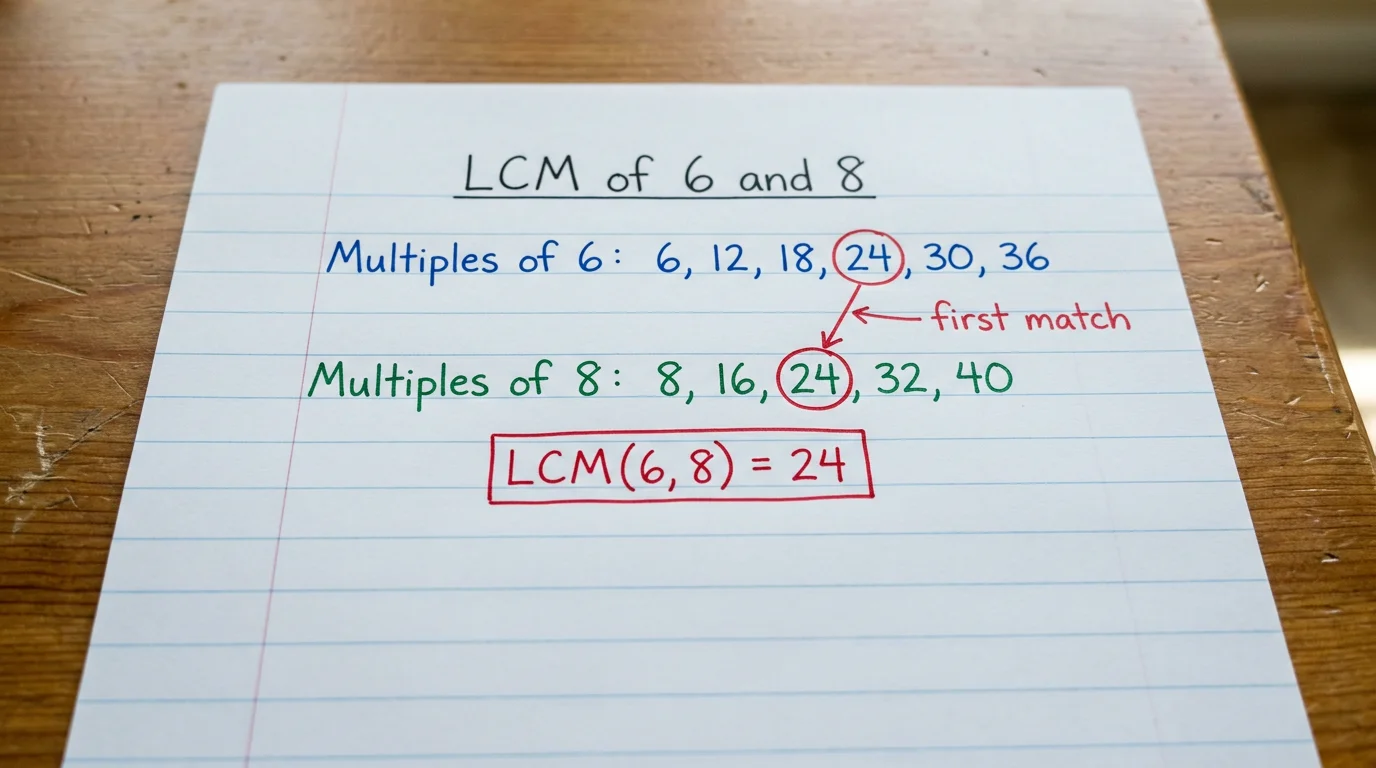
This works well for small numbers and it is easy to check by eye. The trouble starts when the LCM is big. For 18 and 24 you would need to write multiples all the way up to 72, and that is where the next methods save time.
Method 2: Find the LCM with Prime Factorization
Break each number into primes. Then take every prime that appears in either number, at its highest power, and multiply them together. Here is 12 and 18:
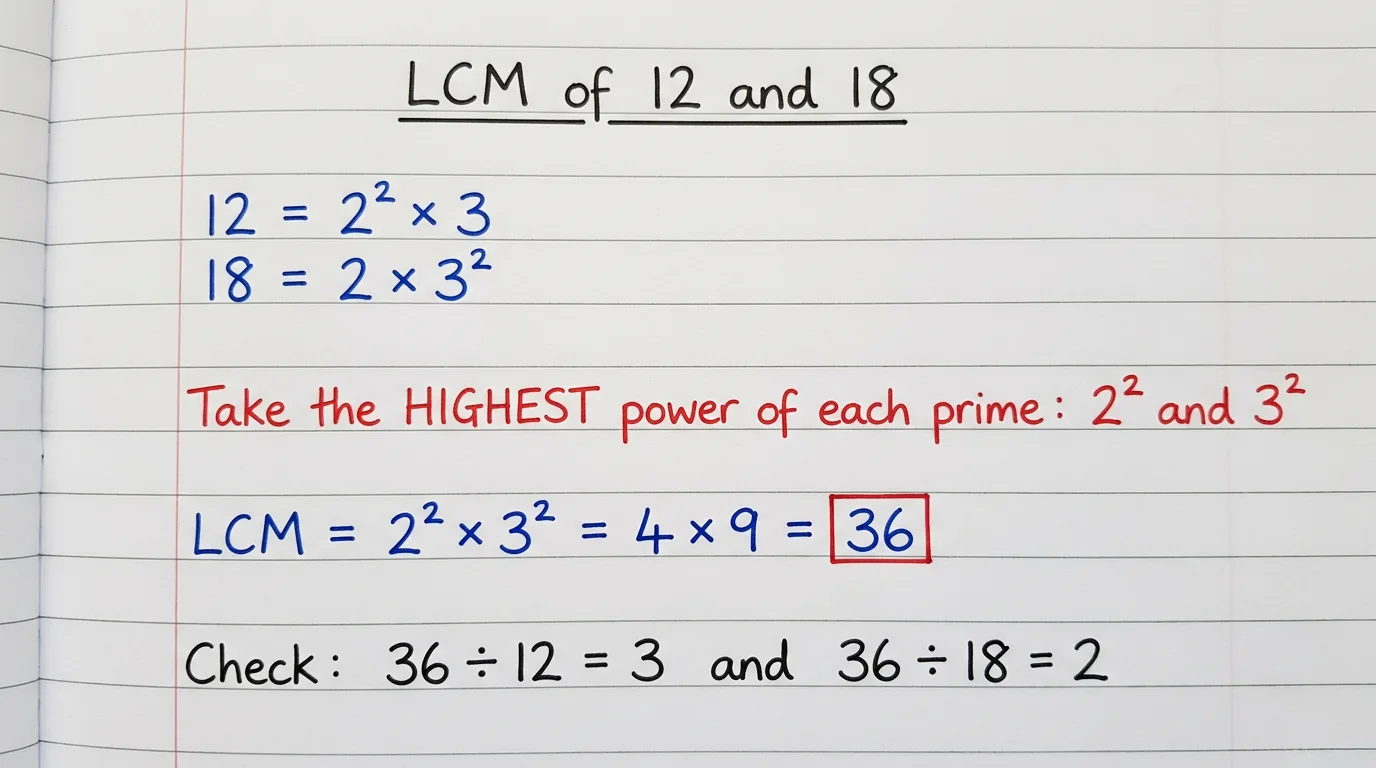
The prime 2 is 2² in 12 and 2¹ in 18, so you take 2². The prime 3 is 3¹ in 12 and 3² in 18, so you take 3². Multiply them and you get 4 × 9 = 36. A fast check at the bottom of the page: 36 ÷ 12 = 3 and 36 ÷ 18 = 2, both whole numbers.
Notice the difference from the GCF. For the GCF you take only the primes that are in both numbers, at the lowest power. For the LCM you take every prime, at the highest power.
Method 3: Find the LCM from the GCF
If you already know the GCF, the LCM is one line of arithmetic:
LCM(a, b) = (a × b) ÷ GCF(a, b)
For 12 and 18 the GCF is 6, so the LCM is 12 × 18 ÷ 6 = 216 ÷ 6 = 36. The same answer as the prime method, with less writing. A tip: divide first, then multiply. 12 ÷ 6 = 2, then 2 × 18 = 36, and you never handle the bigger number 216.
This formula only works for two numbers at a time. Do not use it on three numbers.
Method 4: The Ladder Method for Three or More Numbers
The ladder (or cake) method is the neatest way to find the LCM of three numbers or more. Write the numbers in a row, then keep dividing the row by a prime that goes into at least two of them. Numbers that do not divide just drop down unchanged. Stop when no prime divides two numbers in the row any more.
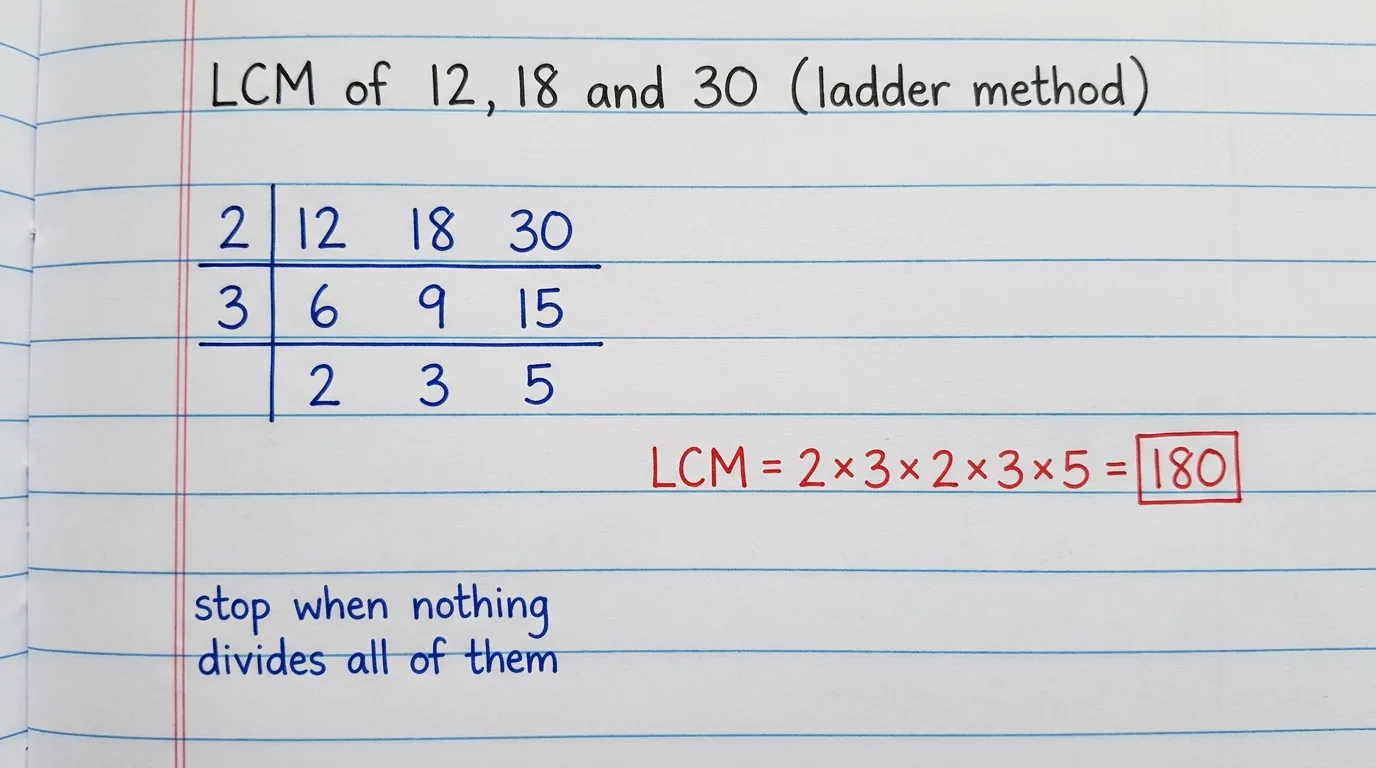
The answer is every number on the left side multiplied by every number left in the bottom row. Here that is 2 × 3 × 2 × 3 × 5 = 180. You can confirm it with primes: 12 = 2² × 3, 18 = 2 × 3² and 30 = 2 × 3 × 5, so the highest powers give 2² × 3² × 5 = 180. And 180 ÷ 12 = 15, 180 ÷ 18 = 10 and 180 ÷ 30 = 6, all whole numbers.
Use the LCM to Add and Subtract Fractions
This is the most common reason students need an LCM. To add fractions with different denominators, rewrite them over the least common denominator, which is just the LCM of the two bottom numbers. For 1/6 + 1/8:
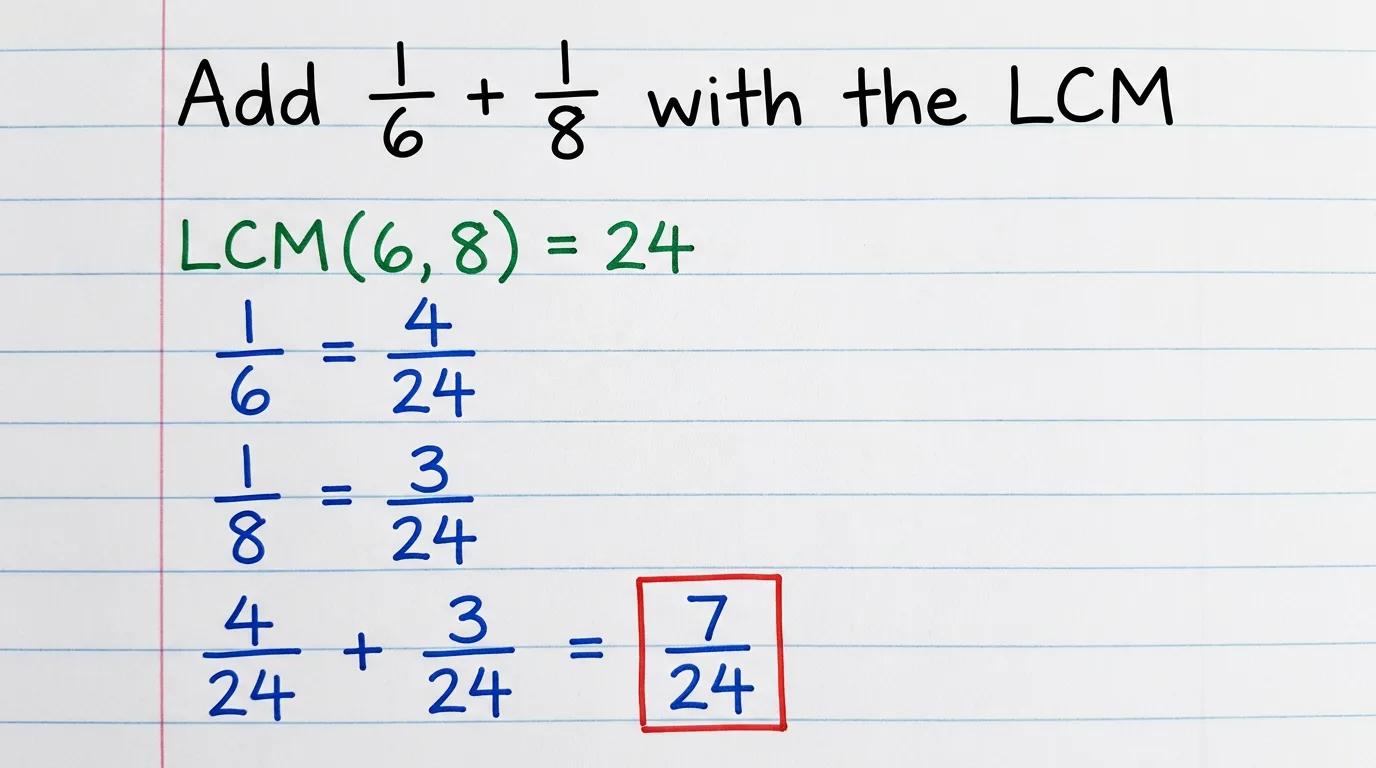
You could use any common multiple, such as 48, but the least one keeps the numbers small, and the answer is already in simplest form most of the time.
LCM Word Problems
Whenever two things repeat on different schedules, ask when they line up again. That is an LCM question.
Two buses
One bus leaves a stop every 12 minutes and another every 15 minutes. They leave together at 8:00. When do they leave together again? LCM(12, 15) = 60, so after 60 minutes, at 9:00.
Blinking lights
A red light blinks every 8 seconds and a blue light every 20 seconds. LCM(8, 20) = 40, so they blink together every 40 seconds. In one minute they blink together once after the start, at second 40.
Buying in packs
Hot dogs come in packs of 10 and buns in packs of 8. To have none left over you need LCM(10, 8) = 40 of each. That means 4 packs of hot dogs and 5 packs of buns.
LCM Shortcuts Worth Remembering
- If the two numbers are coprime (their GCF is 1), the LCM is just their product. LCM(4, 9) = 36.
- Consecutive numbers are always coprime, so LCM(8, 9) = 8 × 9 = 72.
- If one number divides the other, the LCM is the bigger one. LCM(7, 21) = 21.
- The LCM is always a multiple of both numbers, so it is at least as big as the larger of the two.
- Two even numbers always have an even LCM.
Common LCM Mistakes to Avoid
- Answering with the GCF. If your answer is smaller than one of the numbers, it cannot be the LCM.
- Using the lowest power. The LCM needs the highest power of each prime. The lowest power is for the GCF.
- Leaving out a prime. If a prime is in only one of the numbers, it still goes into the LCM.
- Stopping at a common multiple. Any common multiple works for adding fractions, but the LCM is the smallest one.
Type the same numbers into the calculator at the top to check your working.