What Does It Mean to Simplify a Fraction?
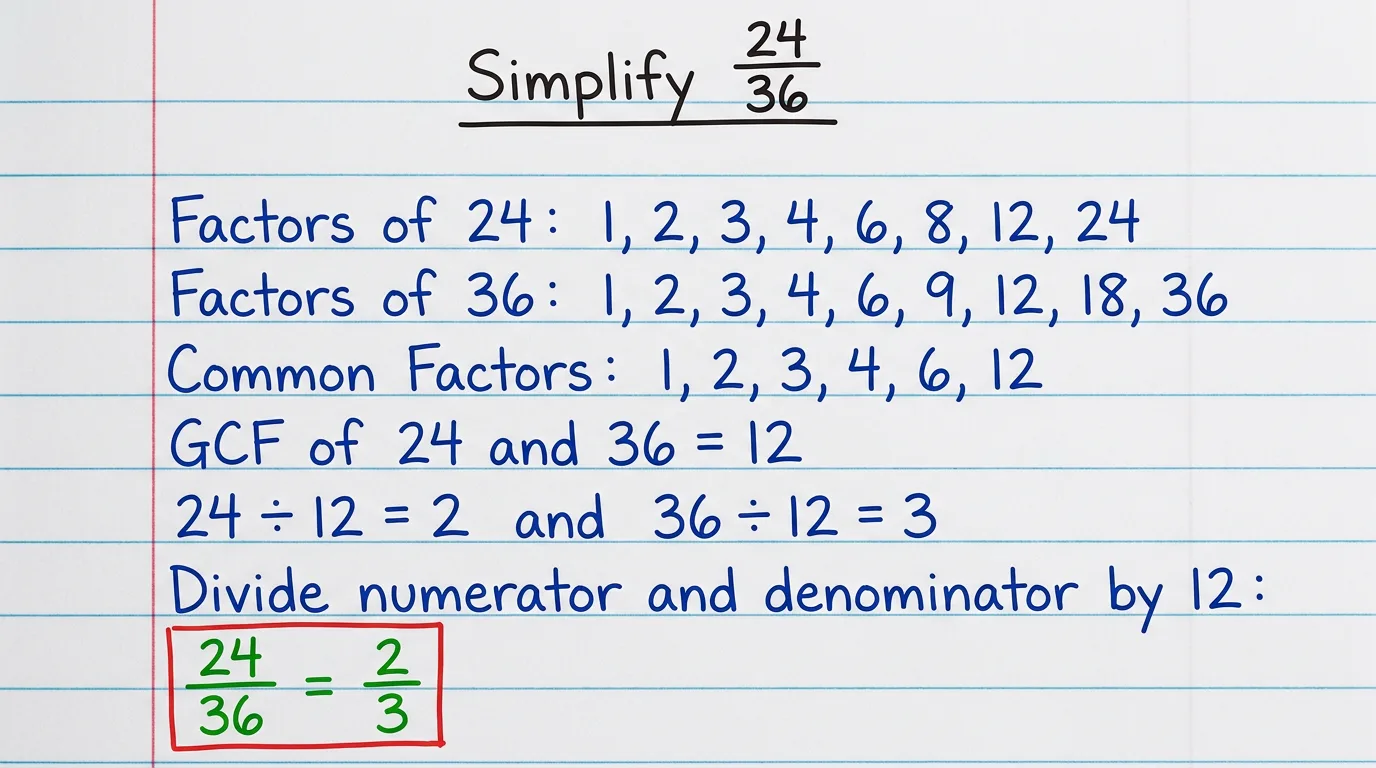
To simplify a fraction means to write it with the smallest whole numbers possible, without changing its value. 24/36 and 2/3 are the same amount, but 2/3 is the simplest form because 2 and 3 have no common factor except 1.
How to Use This Simplify Fractions Calculator
- Type the numerator (top number) into the first box.
- Type the denominator (bottom number) into the second box.
- Press Calculate to see the simplest form, the GCF and the steps behind it.
How to Simplify a Fraction Step by Step
- Find the GCF (greatest common factor) of the top and bottom numbers.
- Divide the numerator by the GCF.
- Divide the denominator by the same GCF.
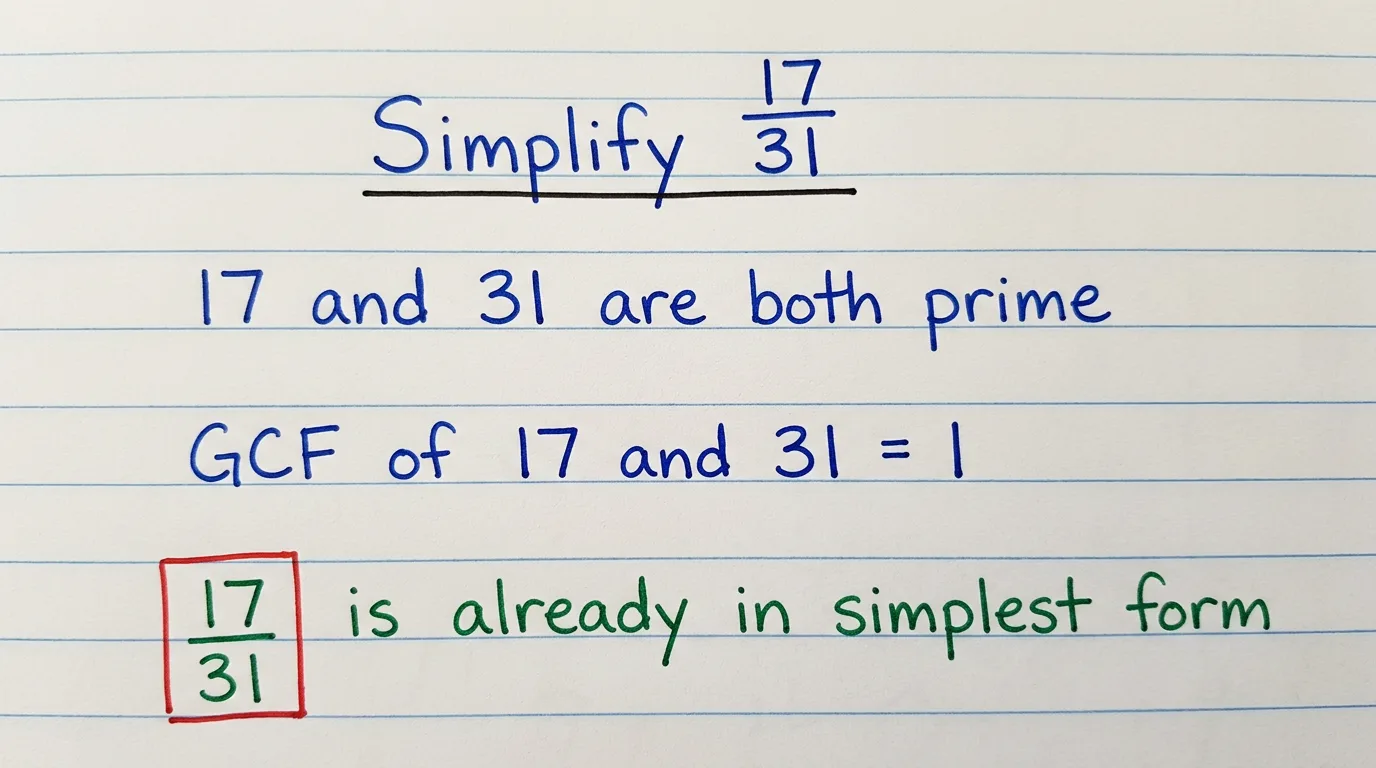
- If the GCF is 1, the fraction is already in simplest form.
Why the Greatest Common Factor Matters
You could divide 24/36 by 2 and get 12/18, then by 6 and get 2/3. That works, but it takes several steps. Dividing by the GCF does the whole job in one go, and you know you are done because nothing is left to cancel.
A Fraction That Cannot Be Simplified
If the GCF is 1, the numbers are coprime and the fraction is already in simplest form. 17/31 is one of them, because 17 and 31 are both prime and share nothing.
Worked Examples
- Simplify 24/36 = 2/3
- Simplify 48/180 = 4/15
- Simplify 84/126 = 2/3
- Simplify 17/31 is already in simplest form
Common mistakes
- Dividing only the top or only the bottom. You must divide both by the same number.
- Stopping too early. Dividing 48/180 by 2 gives 24/90, which can still be reduced. Use the GCF to finish in one step.
- Subtracting instead of dividing. 24/36 is not 12/24. Simplifying always uses division.