What Is Prime Factorization?
Prime factorization means writing a number as a product of prime numbers and nothing else. For example, 60 = 2 × 2 × 3 × 5. Every number on the right is prime, so you cannot break any of them down any further.
There is one neat fact behind all of this. Every whole number bigger than 1 has exactly one prime factorization, apart from the order you write it in. Mathematicians call that the Fundamental Theorem of Arithmetic. It is why the answer you get here will always match the answer in the back of your book.
Prime Numbers and Composite Numbers
A prime number has exactly two factors: 1 and itself. A composite number has more than two. The number 1 is neither, because it has only one factor. And 2 is the only even prime.
The primes up to 50 are worth knowing by heart: 2, 3, 5, 7, 11, 13, 17, 19, 23, 29, 31, 37, 41, 43, 47. That is 15 of them.
How to Use This Prime Factorization Calculator
- Type a whole number into the box. Use Paste if you have it copied.
- Press Calculate, or hit Enter.
- Read the prime factorization, the factor tree, every factor of the number and its factor pairs.
Method 1: Prime Factorization with a Factor Tree
Split the number into any two factors. Then split each of those, and keep going until every branch ends in a prime. Circle the primes as you go. Here is 72:
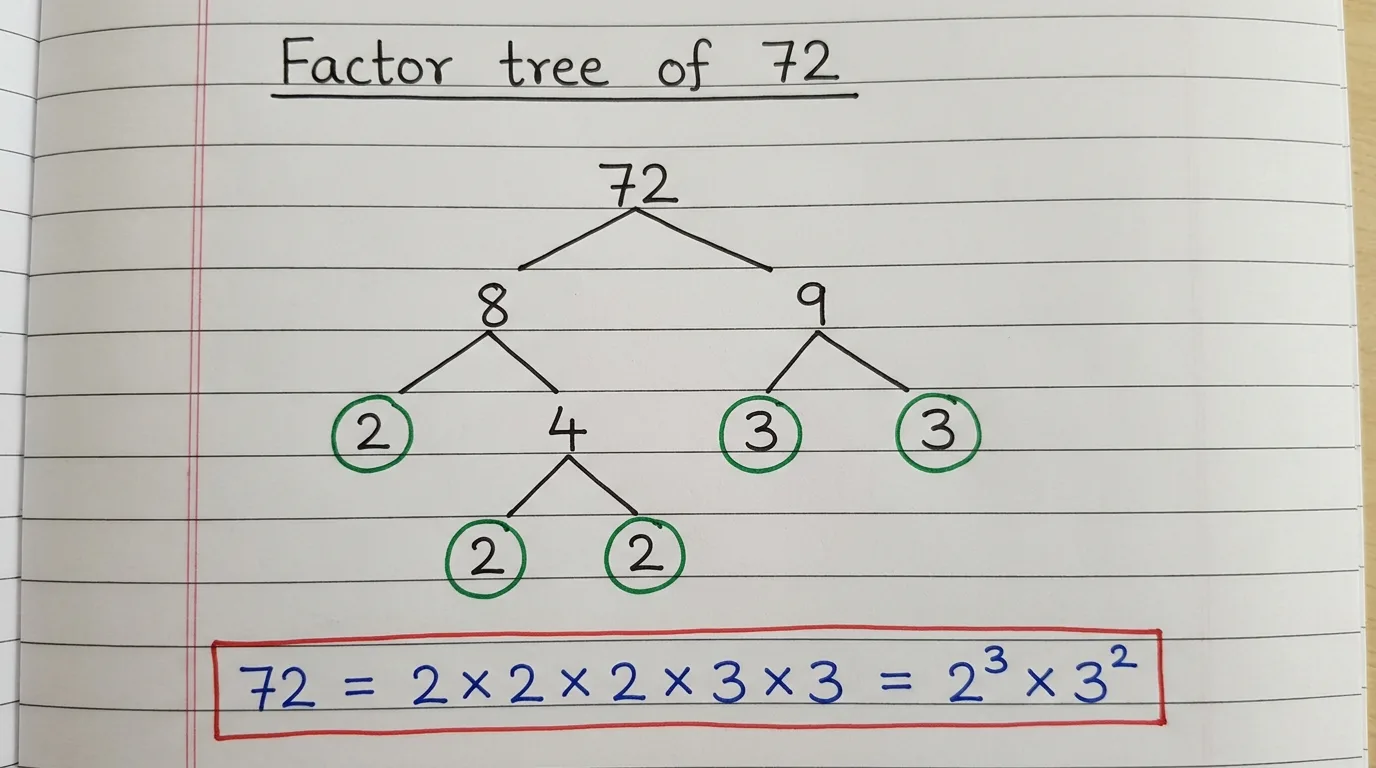
You can start the tree with any pair. If you split 72 as 6 × 12 instead, you end up with the same five primes, just in a different order. That is the unique-answer rule at work.
Method 2: The Division Ladder
The ladder is faster to write than a tree. Divide by the smallest prime that goes in, write the answer below, and repeat until you reach 1.
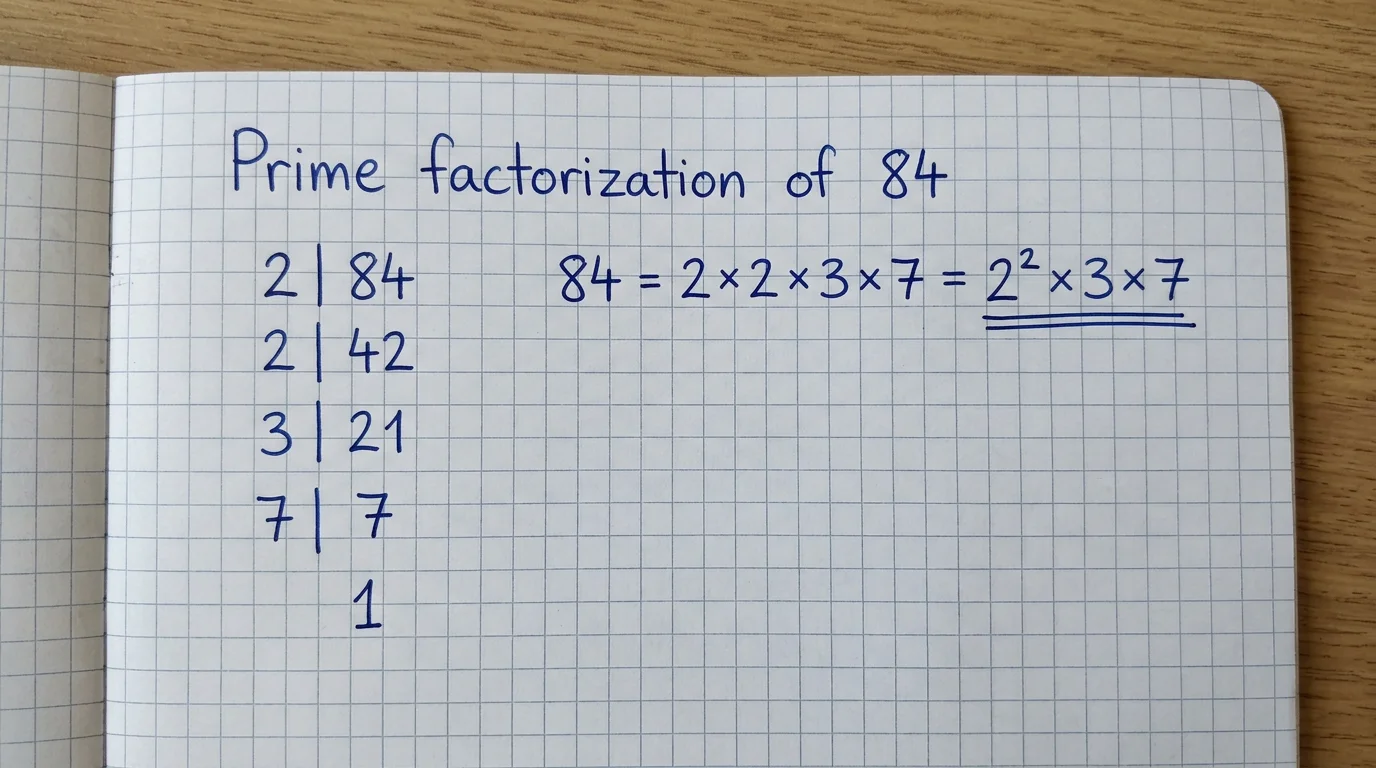
The numbers on the left are your prime factors. Always try the primes in order, 2, 3, 5, 7, 11, and stay on a prime until it stops dividing evenly.
Quick Divisibility Rules That Speed It Up
- 2: the last digit is even (0, 2, 4, 6 or 8).
- 3: the digits add up to a multiple of 3. For 252, 2 + 5 + 2 = 9, so 3 goes in.
- 5: the number ends in 0 or 5.
- 11: subtract and add the digits in turn. For 1,001: 1 − 0 + 0 − 1 = 0, so 11 goes in.
That last one is handy. 1,001 = 7 × 11 × 13, three primes in a row. You can see it worked out step by step on the factors of 1,001 page.
How to Tell If a Number Is Prime
You do not have to test every number below it. You only test the primes up to the square root of the number. If none of them divide it, the number is prime. Let us test 91:
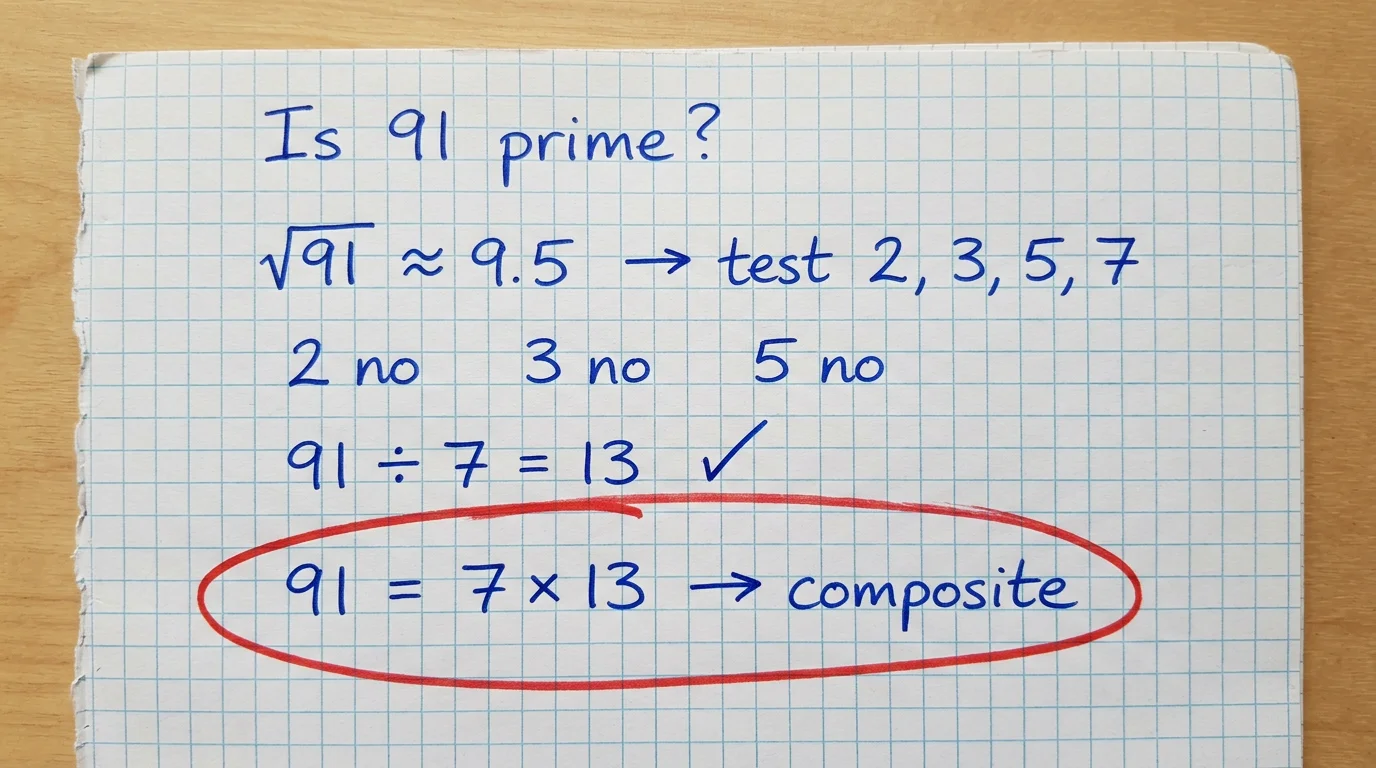
91 looks prime because it is not even, does not end in 5 and the digits add up to 10. It is a classic trap. The prime 7 goes in, so 91 = 7 × 13.
Write the Answer with Exponents
When a prime repeats, group it with an exponent. So 2 × 2 × 2 × 3 × 3 becomes 2³ × 3². This short form is called exponential form, and it is the form most teachers ask for. The little number tells you how many times that prime appears.
Count the Factors of a Number
Once you have the prime factorization, you can count all the factors without listing them. Add 1 to each exponent, then multiply the results. For 72 = 2³ × 3²:
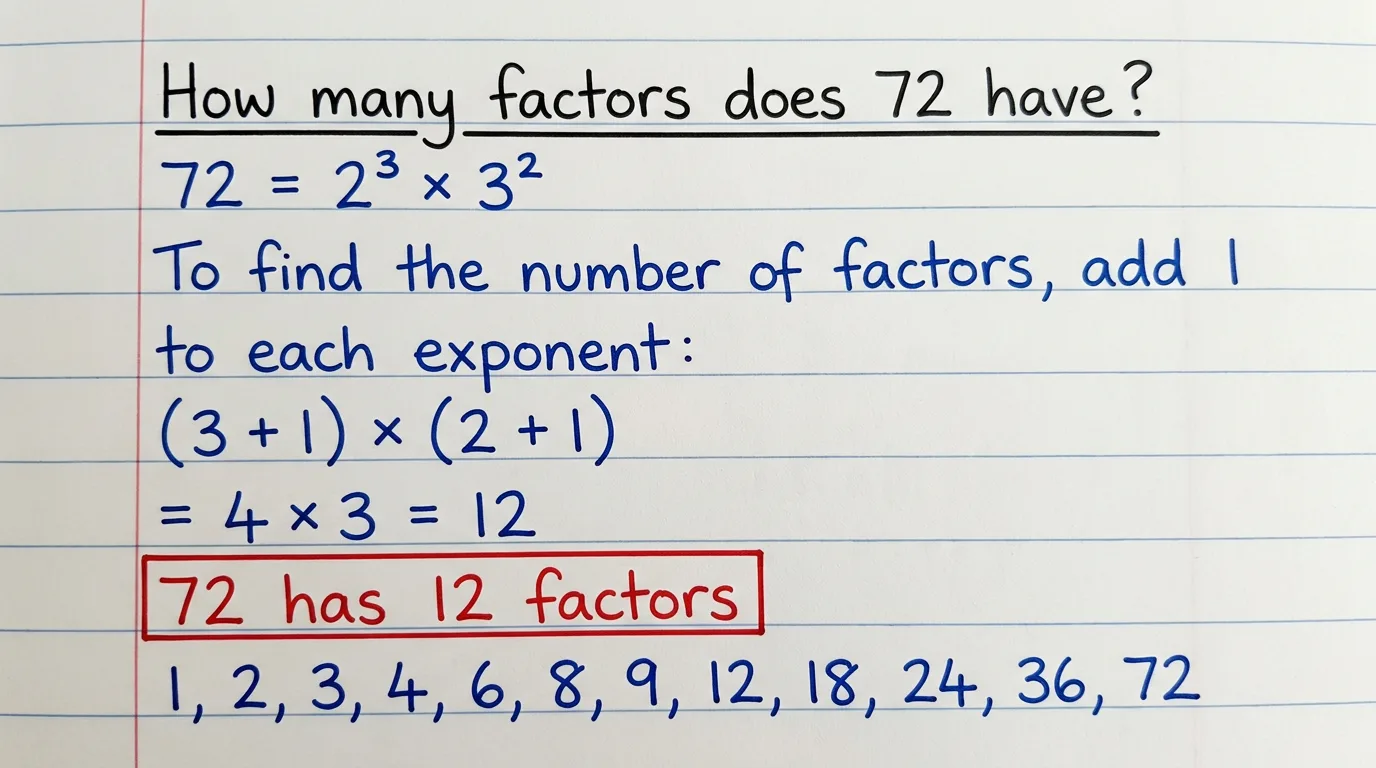
The rule works because each factor picks between 0 and 3 twos, and between 0 and 2 threes. That is 4 choices for the twos and 3 for the threes, so 4 × 3 = 12 factors.
What You Can Do with Prime Factorization
Find the GCF and LCM
With both numbers in prime form, the GCF takes the shared primes at the lowest power, and the LCM takes every prime at the highest power. Use our GCF calculator or LCM calculator to check.
Simplify square roots
72 = 2³ × 3² = (2² × 3²) × 2, and the square part comes out of the root. So √72 = 2 × 3 × √2 = 6√2.
Spot perfect squares
A number is a perfect square when every exponent in its prime factorization is even. 144 = 2⁴ × 3², and both exponents are even, so 144 = 12².
Common Prime Factorization Mistakes
- Calling 1 a prime. It is not. Never put 1 in a factorization.
- Stopping too early. If a number in your answer is composite, such as 4 or 9, keep splitting it.
- Giving the factors, not the primes. The factors of 12 are 1, 2, 3, 4, 6 and 12. The prime factorization is 2² × 3.
- Skipping a repeat. 8 = 2 × 2 × 2, not 2 × 4. Check by multiplying everything back together.
Whichever method you use, multiply your primes back together at the end. If you get the number you started with, the factorization is right.