How Many Factors Does a Number Have?
You do not have to list every factor to count them. Write the number as a product of primes, add 1 to each exponent, and multiply. That one short calculation gives the number of factors.
How to Use This Number of Factors Calculator
- Type any whole number into the box.
- Press Calculate to see the count, the formula and the full list of factors.
How to Count the Factors
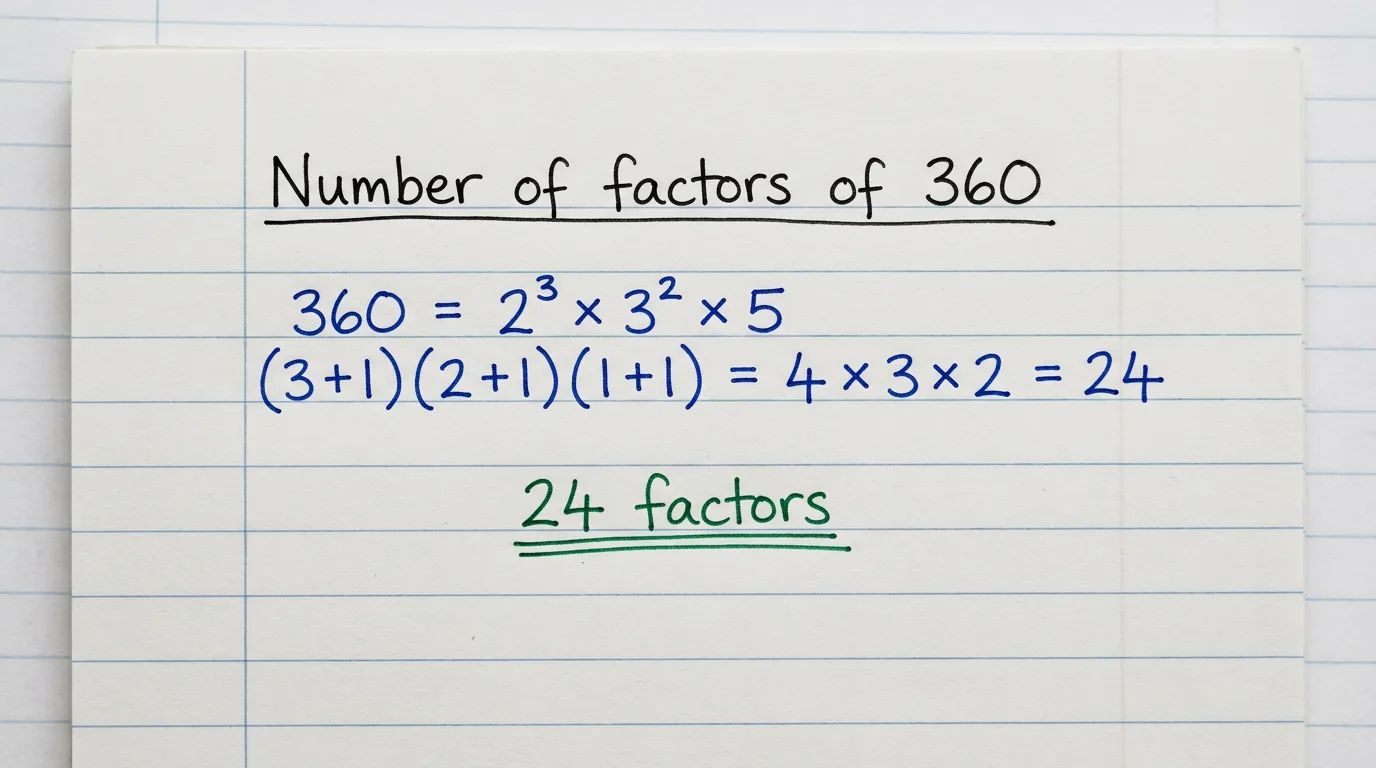
- Find the prime factorization, such as 360 = 2³ × 3² × 5.
- Add 1 to every exponent: (3 + 1), (2 + 1), (1 + 1).
- Multiply: 4 × 3 × 2 = 24 factors.
Why Adding 1 Works
A factor can use a prime zero times, once, or up to its full exponent. A prime with exponent 3 has 4 choices: 0, 1, 2 or 3 copies. The choices for different primes are independent, so you multiply them.
Perfect Squares Have an Odd Count
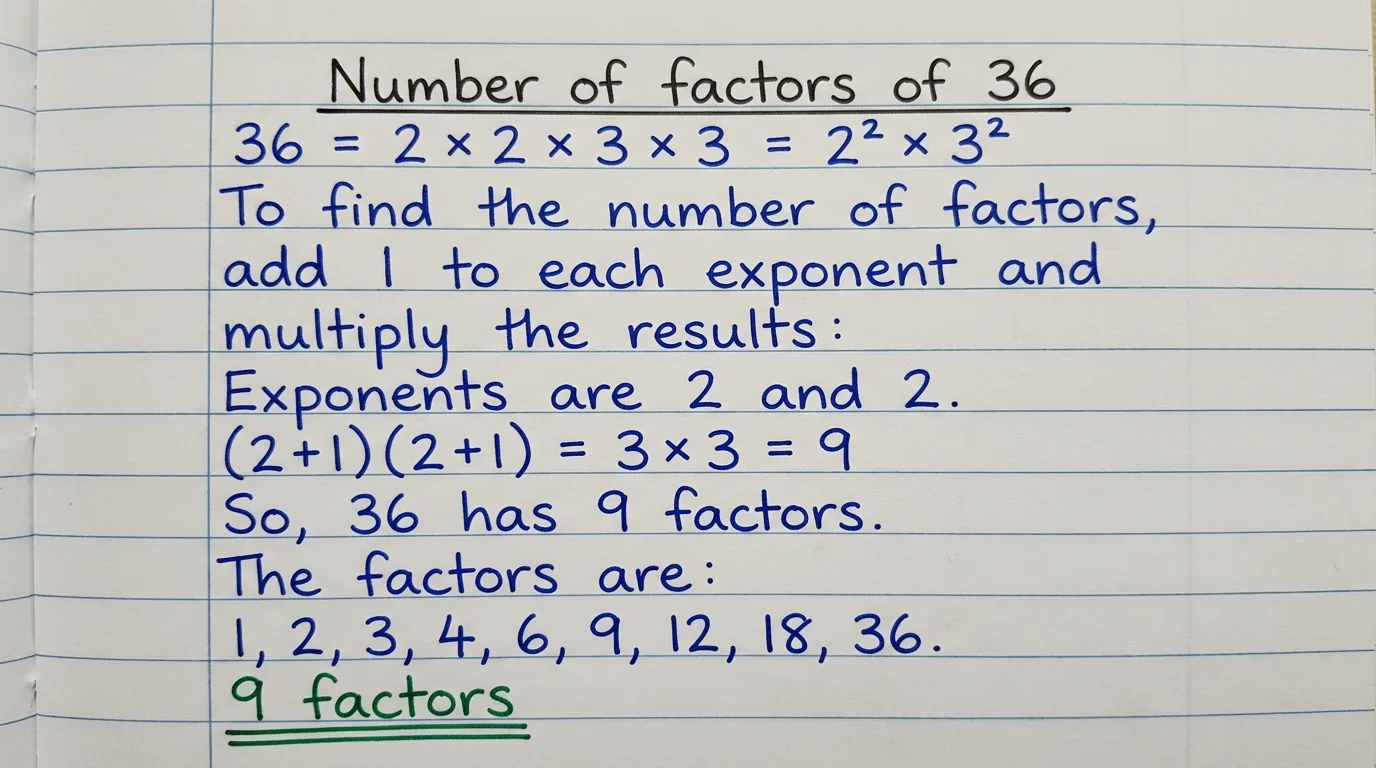
Factors normally come in pairs. In a perfect square like 36, the middle factor 6 pairs with itself, so 36 has 9 factors, an odd number.
Worked Examples
- Number of factors of 36 = 9
- Number of factors of 48 = 10
- Number of factors of 360 = 24
- Number of factors of 1,001 = 8
Common mistakes
- Counting the primes instead of the factors. 360 has only 3 different primes but 24 factors.
- Forgetting to add 1. The exponents 3, 2 and 1 give 6, not 24.
- Leaving out 1 or the number itself. Both are factors and both are counted.