What Are the Factors of 1,001?
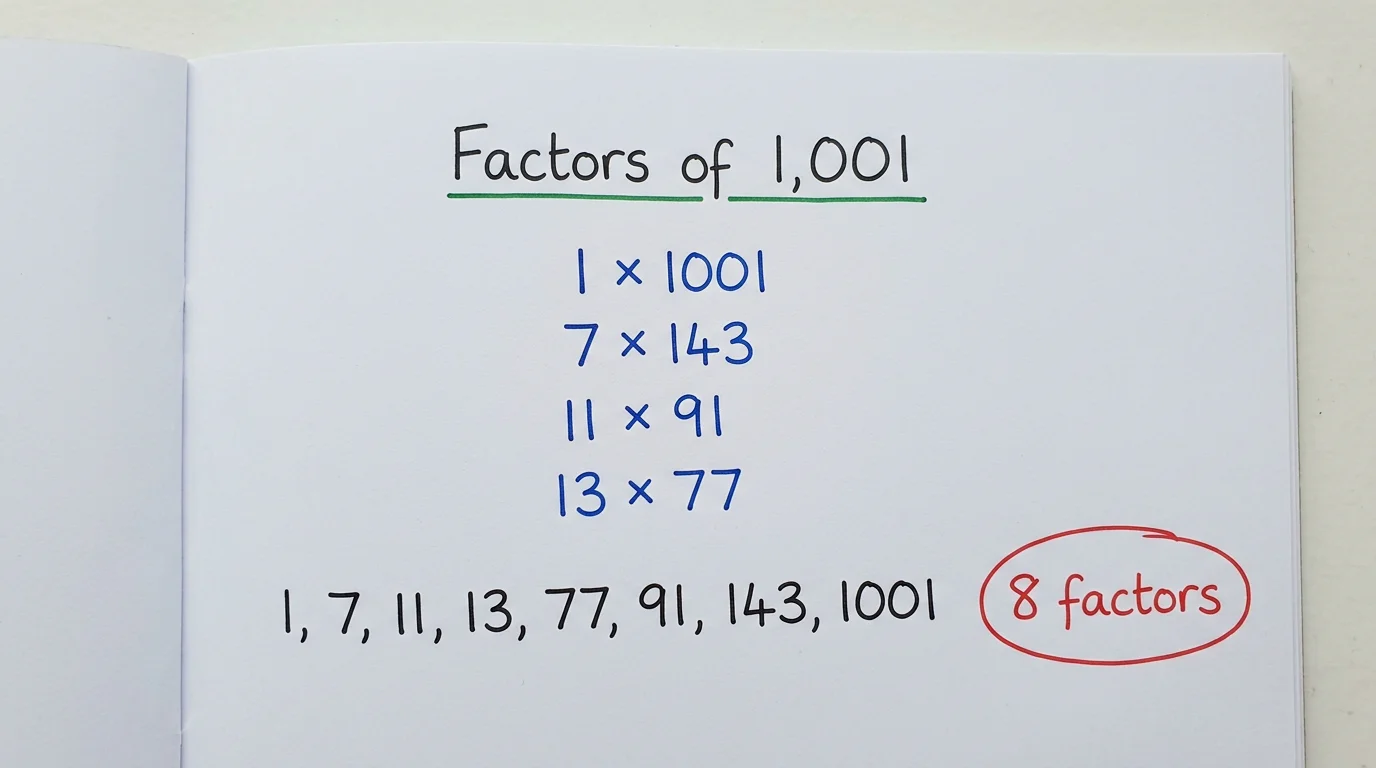
At first glance 1,001 looks like it should be prime. It is not. The factors of 1,001 are 1, 7, 11, 13, 77, 91, 143 and 1,001. That is eight factors, and the three small ones, 7, 11 and 13, are the stars of this page.
Factor Pairs of 1,001
The square root of 1,001 is about 31.6, so in theory you test every number up to 31. In practice almost everything fails fast. 2, 3 and 5 do not work, but 7 does, and then the rest falls into place.
Prime Factorization of 1,001 Is 7 × 11 × 13
Test the small primes in order. 1,001 ÷ 7 = 143, and 143 splits as 11 × 13. All three numbers are prime, so the tree stops there.
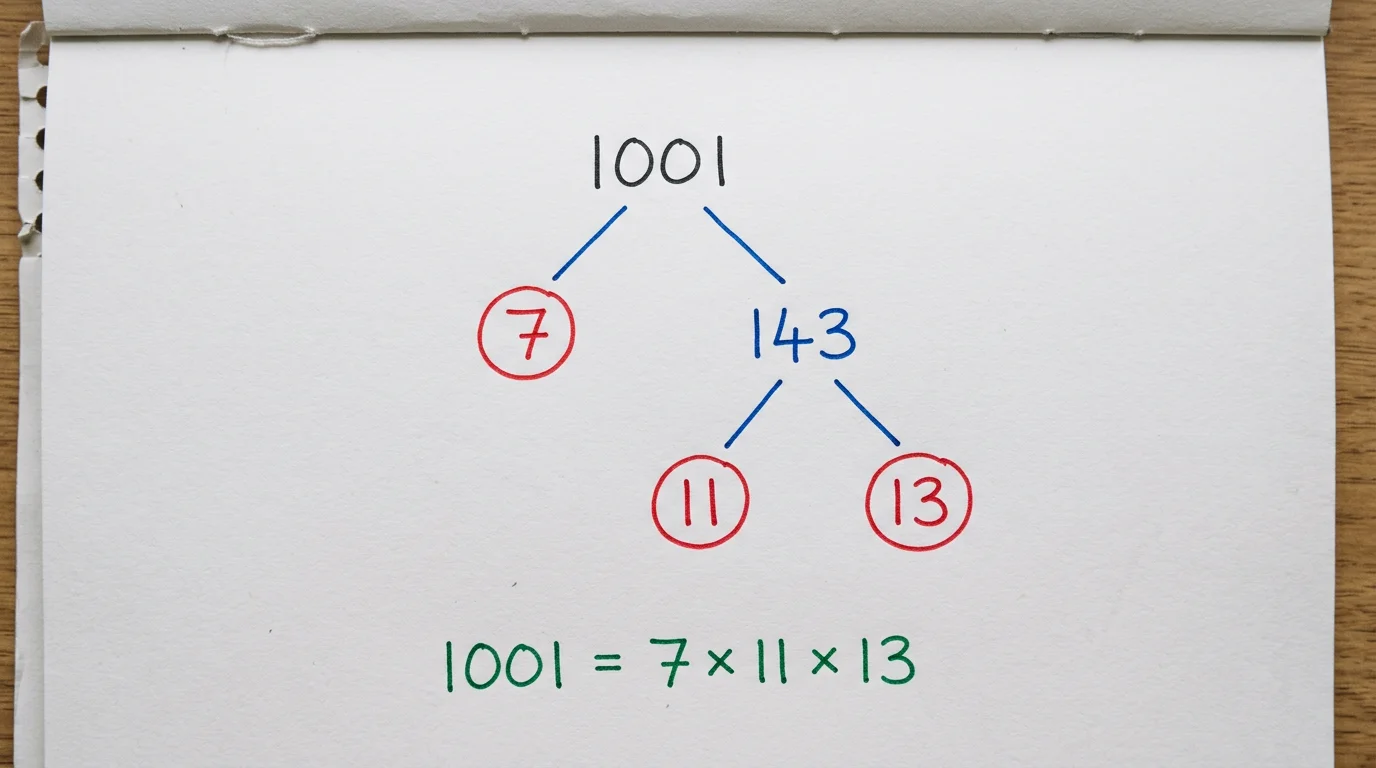
So 1,001 = 7 × 11 × 13. These are three consecutive primes, and every exponent is 1. Using the factor count shortcut, (1 + 1) × (1 + 1) × (1 + 1) = 8. The sum of the factors is (1 + 7) × (1 + 11) × (1 + 13) = 8 × 12 × 14 = 1,344.
Another way to see it: 1,001 = 10³ + 1, and numbers of the form a³ + 1 always split. Here that is (10 + 1) × (100 − 10 + 1) = 11 × 91.
The 1001 Magic Trick
Ask a friend to pick any three-digit number, say 482. Tell them to multiply it by 1,001 and watch their face:
482 × 1,001 = 482,000 + 482 = 482,482. The number simply repeats itself.
That works because 1,001 = 1,000 + 1. And since 1,001 = 7 × 11 × 13, the repeated number is always divisible by 7, 11 and 13. Check it: 482,482 ÷ 7 = 68,926, ÷ 11 = 43,862 and ÷ 13 = 37,114, all whole numbers.
A Divisibility Test for 7, 11 and 13 All at Once
Because 1,001 is built from these three primes, one test covers all of them. Split a big number into groups of three digits from the right, then add and subtract the groups in turn.
- Take 123,456,789 and split it: 123 | 456 | 789.
- Compute 789 − 456 + 123 = 456.
- Test 456 instead: it is not divisible by 7, 11 or 13, so neither is 123,456,789.
Try 8,008: 8 − 8 = 0, and 0 is divisible by everything, so 8,008 is divisible by 7, 11 and 13. It is 8 × 1,001.
Is 1,001 Prime or Composite?
Composite. It is a classic trap, a number that feels prime because it looks symmetrical. The only way to be sure is to test the primes up to its square root, and 7 breaks the spell immediately. Fun fact: One Thousand and One Nights is the famous collection of stories, so you have probably heard this number already.
Common Factors of 1,001 With Other Numbers
- 1,001 and 143: GCF is 143, because 143 divides 1,001 exactly.
- 1,001 and 77: GCF is 77.
- 1,001 and 91: GCF is 91.
Simplify fractions with 1,001 on the bottom
77/1,001 = 1/13 (divide by 77), and 91/1,001 = 1/11 (divide by 91). Spotting the hidden factors makes these fractions shrink instantly.