What Are the Factors of 100?
The factors of 100 are 1, 2, 4, 5, 10, 20, 25, 50 and 100. There are nine of them, and you already use most of them every day without noticing, every time you see a percentage.
Factor Pairs of 100
Start with 1 × 100, then test each number in turn. 3 fails (100 ÷ 3 leaves 1), but 4 works, and so on until the pairs meet in the middle at 10.
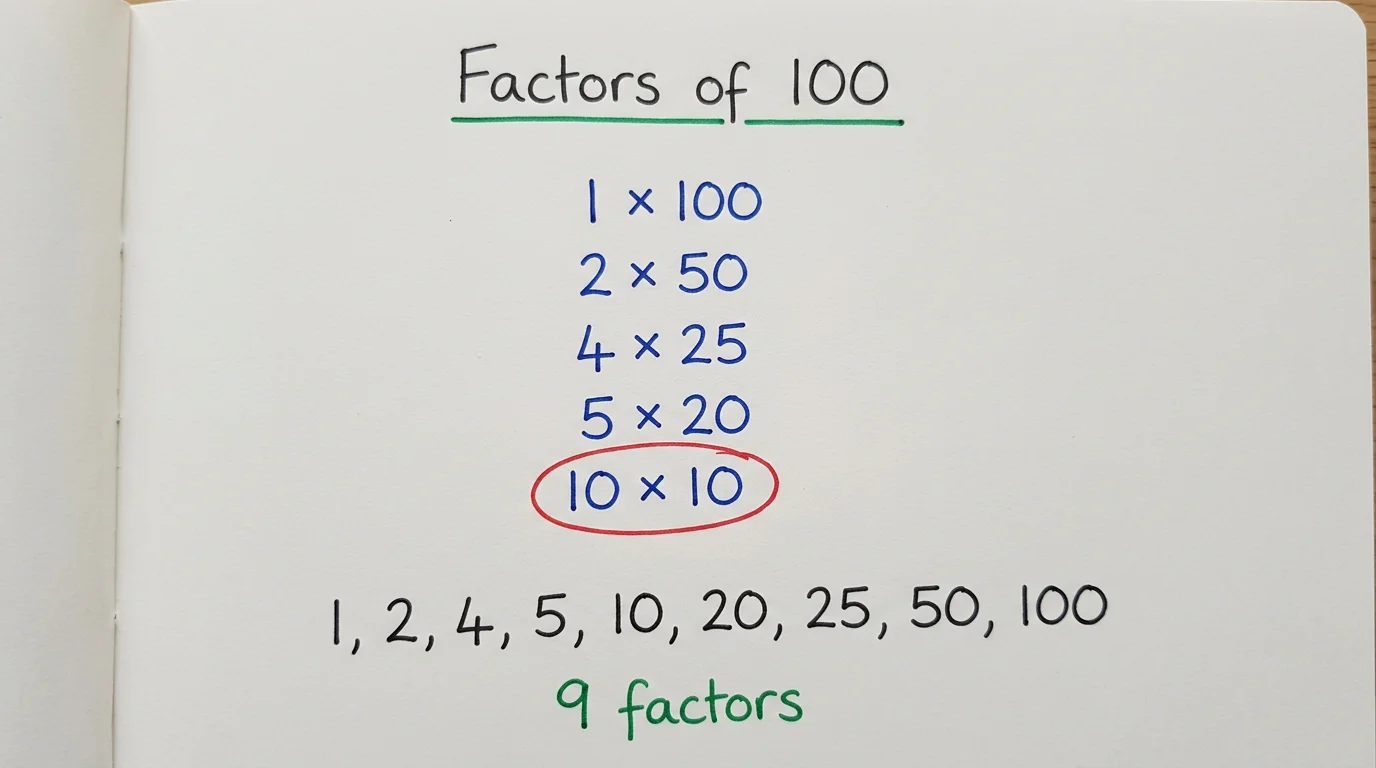
Because 10 × 10 = 100, the number 100 is a perfect square, and that is why it has an odd count of factors.
Prime Factorization of 100 With a Factor Tree
The easiest start is 10 × 10, since 10 is just 2 × 5.
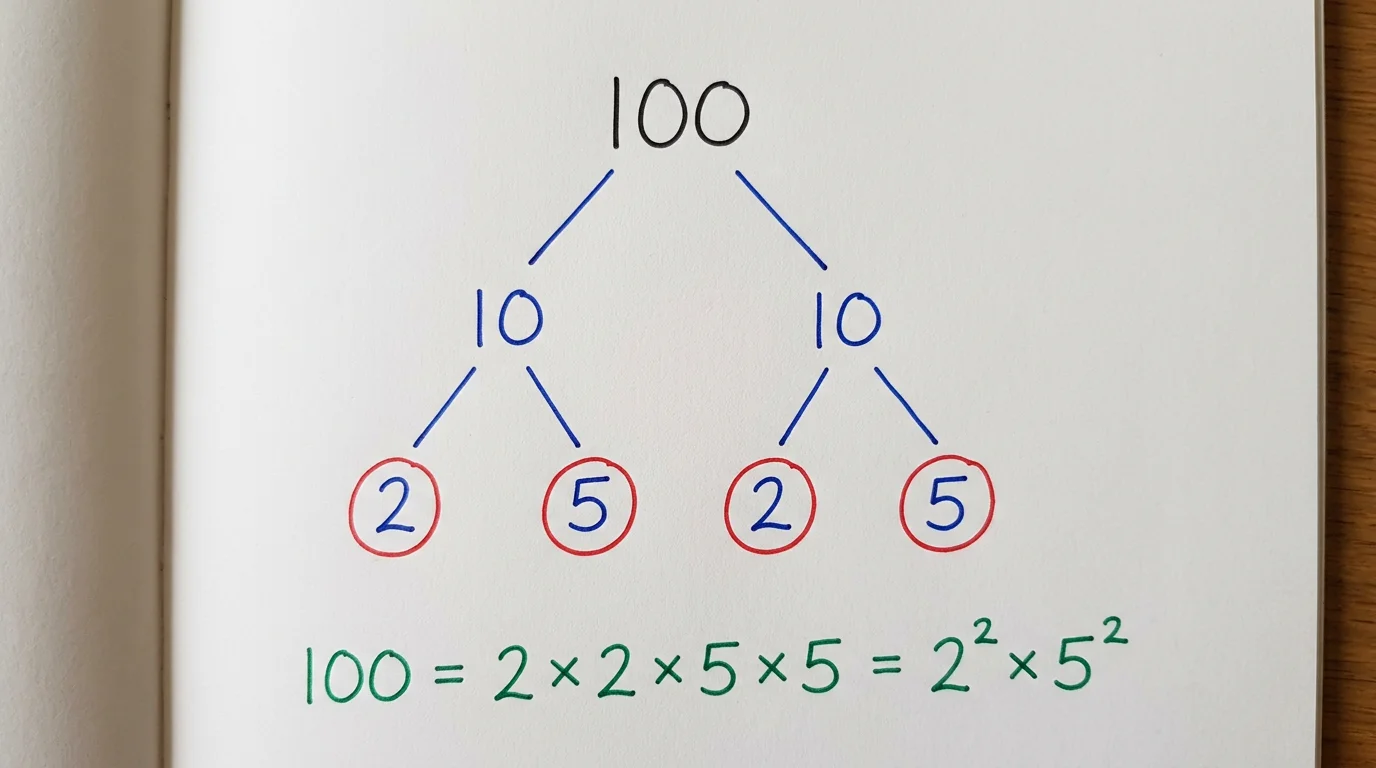
So 100 = 2 × 2 × 5 × 5 = 2² × 5², which is the same as (2 × 5)² = 10². Only two different primes show up, 2 and 5. Count the factors with (2 + 1) × (2 + 1) = 9.
Factors of 100 and Percent
The word percent literally means “per hundred”, so the factors of 100 are the fractions you can write as a whole-number percent:
- 1/2 = 50/100 = 50%
- 1/4 = 25/100 = 25%
- 1/5 = 20/100 = 20%
- 1/10 = 10/100 = 10%
- 1/20 = 5/100 = 5%
- 1/25 = 4/100 = 4%
Money works the same way. A dollar is 100 cents, so it splits into 4 quarters (100 ÷ 25), 10 dimes (100 ÷ 10) or 20 nickels (100 ÷ 5).
Why 3 Is Not a Factor of 100
Add the digits of 100 and you get 1 + 0 + 0 = 1, which is not a multiple of 3, so 3 can never divide it. The same goes for 6, 7, 8 and 9. That is why 1/3 of a dollar is not a clean number of cents (33.33…) while 1/4 of a dollar is a neat 25 cents.
There is a deeper reason, too. The primes in 100 are only 2 and 5, and our decimal system is built on 10 = 2 × 5. Fractions whose denominators use only 2s and 5s, like 1/4 or 3/20, become tidy decimals. Others, like 1/3, repeat forever.
Is 100 Prime or Composite?
Composite, with nine factors that add up to 217. It is a perfect square, a power of ten and the favourite number of every percentage question.
Common Factors of 100 With Other Numbers
Simplify a fraction with the GCF
- List the factors of 100 and of 60. The shared ones are 1, 2, 4, 5, 10 and 20.
- The biggest shared factor is 20.
- Divide both numbers by 20: 60/100 becomes 3/5.
With 150 the GCF is 50, and with 80 it is 20. Try your own pair in the calculator to see the shared factors highlighted.