What Are the Factors of 21?
A single die has 21 dots in total, and 21 splits into 3 groups of 7 or 7 groups of 3. Every one of those tidy splits is a factor: a whole number that divides another number exactly, with no remainder.
The factors of 21 are 1, 3, 7 and 21. That is four factors.
Factor Pairs of 21
Look for pairs that multiply to 21, working from the outside in.
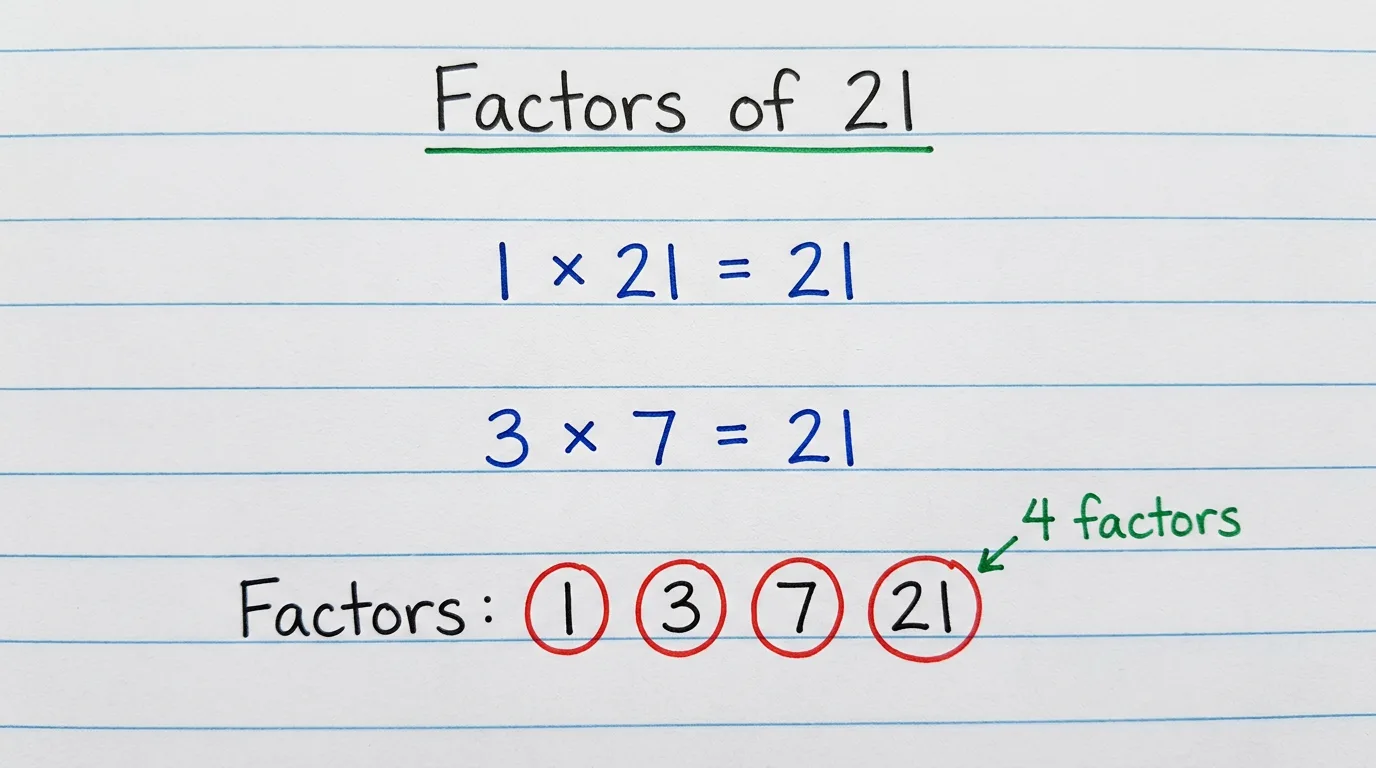
- Start with 1 × 21.
- Try 3. Since 21 ÷ 3 = 7, write 3 × 7.
- Keep trying whole numbers until you reach 7, which is already in your list. Every factor is now found, so you are done.
Prime Factorization of 21
Prime factors show what 21 is built from. Split it and keep going until every branch is a prime.
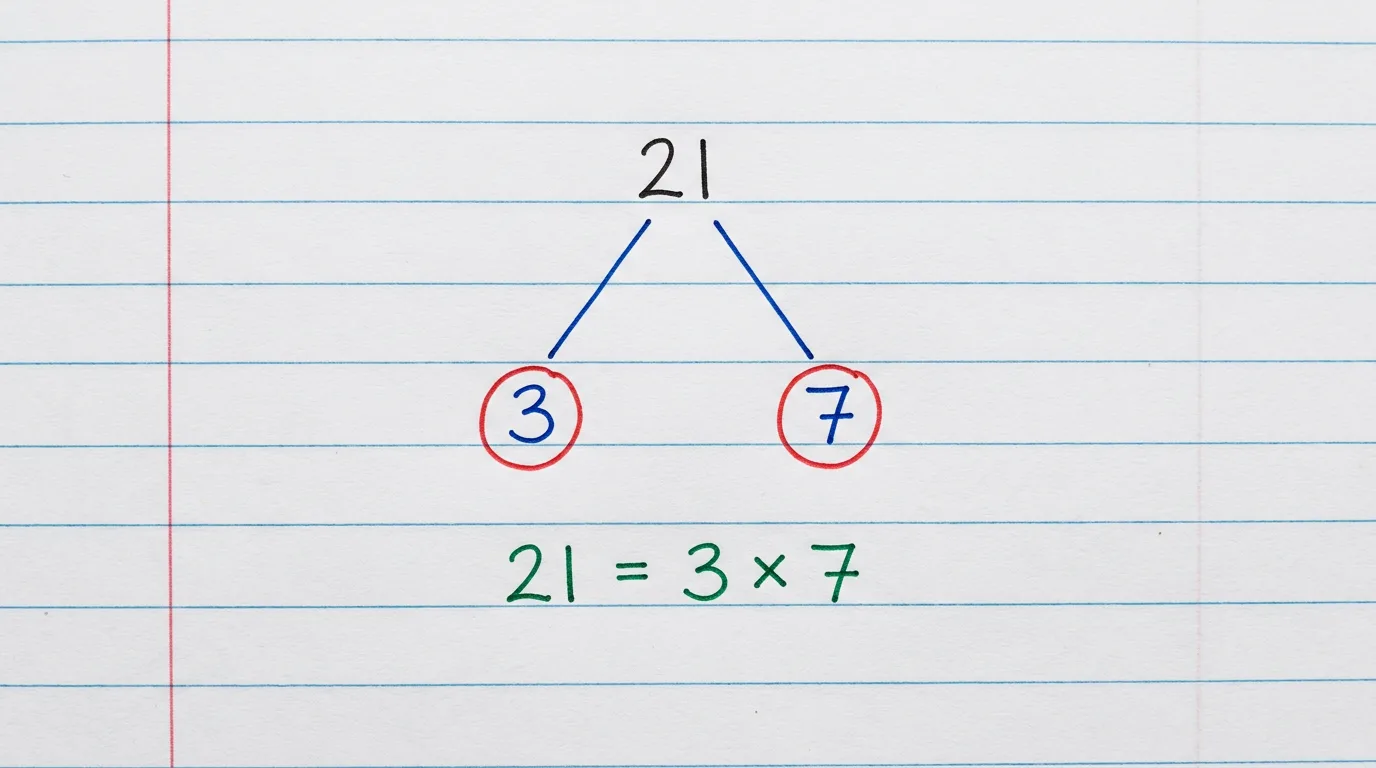
So 21 = 3 × 7. Its prime factors are 3 and 7. Each prime appears once, so the count is (1 + 1) × (1 + 1) = 4, which matches the list.
Divisibility check for 21
A number divides by 21 when it divides by 3 and 7. Take 63: its digits add up to 9, and 63 ÷ 7 = 9, so 63 is a multiple of 21.
Is 21 a Prime or Composite Number?
Composite. It has four factors. The sum of all factors is 1 + 3 + 7 + 21 = 32. The factors smaller than 21 add up to 11, which is less than 21, so 21 is called a deficient number.
Real-Life Uses of the Factors of 21
- Dice. One die has 21 dots in total, and 21 = 3 × 7.
- Weeks. Twenty-one days is exactly 3 weeks.
- Rows. Twenty-one chairs fit in 3 rows of 7 or 7 rows of 3.
Common Factors of 21 With Other Numbers
The factors of 35 are 1, 5, 7 and 35, so 21 and 35 share 1 and 7. The GCF is 7, which simplifies 21/35 to 3/5.
Quick Practice
Which of these are factors of 21: 5, 7 or 8? Only 7. Now try 28 and check it with the calculator.