What Are the Factors of 36?
The factors of 36 are 1, 2, 3, 4, 6, 9, 12, 18 and 36. Count them and you get nine, an odd number. That is a clue that 36 is a little bit special, and by the end of this page you will know exactly why.
Factor Pairs of 36 and the Lonely 6 × 6
Factors come in pairs, because every division gives you two numbers: the divisor and the answer. For 36, the pairs are lined up below.
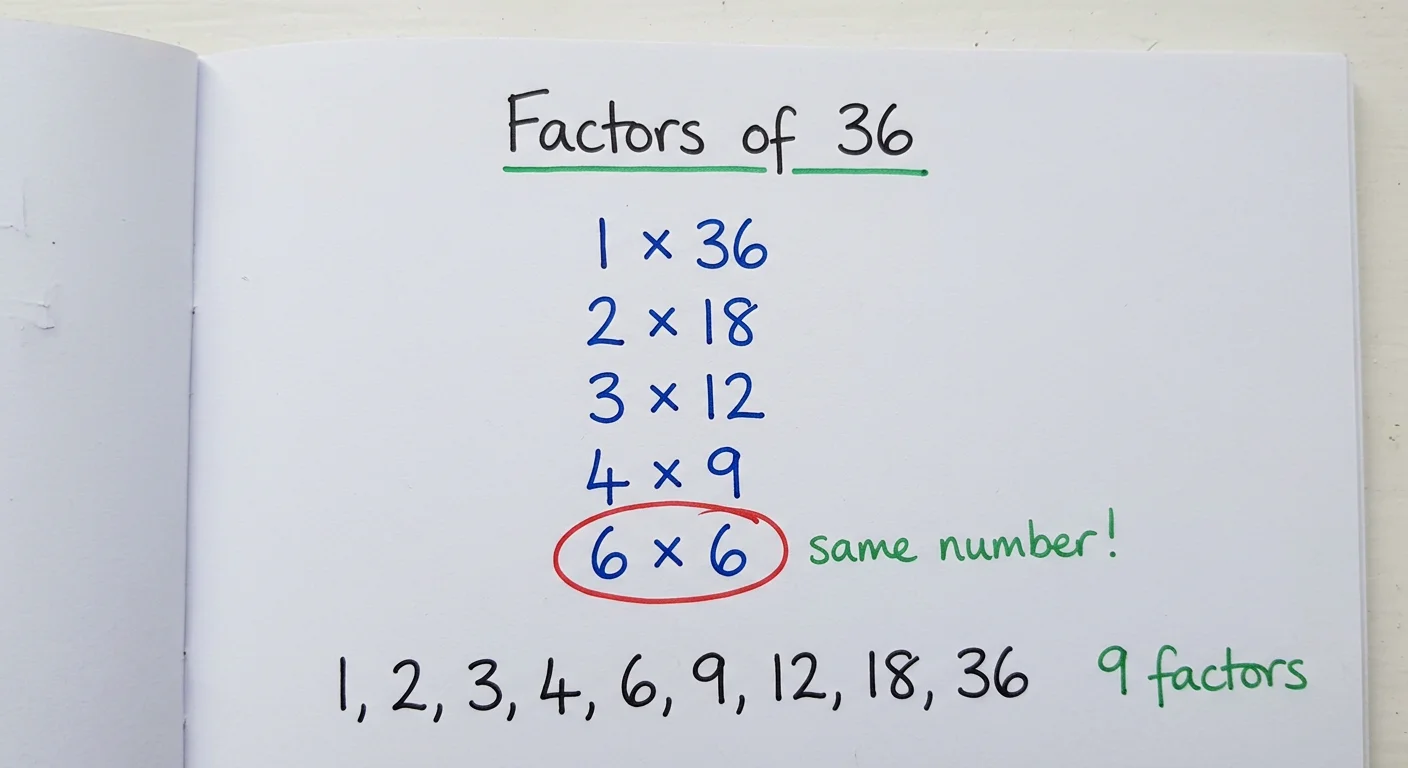
See the circled 6 × 6? A pair needs two different numbers, but here both are 6. You only write 6 once in your list, and that is the whole secret behind the odd count.
Why 36 Has an Odd Number of Factors
Most numbers have an even number of factors because everything pairs off. The exception is a perfect square. Since 36 = 6², one factor is paired with itself and gets left over. Four full pairs plus the single 6 makes 4 × 2 + 1 = 9. The same is true for 4, 9, 16, 25, 49 and every other perfect square.
The Locker Puzzle: Which of 36 Lockers Stay Open?
Imagine 36 closed lockers and 36 students. Student 1 opens every locker. Student 2 flips every 2nd locker, student 3 flips every 3rd, and so on up to student 36. At the end, which lockers are open?
Locker 36 gets flipped by students 1, 2, 3, 4, 6, 9, 12, 18 and 36, which are exactly its factors. Nine flips is an odd number, so the locker ends up open. A locker stays open only when it has an odd number of factors, and that only happens for perfect squares: lockers 1, 4, 9, 16, 25 and 36.
Prime Factorization of 36 With a Factor Tree
Because 36 = 6 × 6, a tree starts with two 6s. Each 6 splits into 2 × 3, and every leaf is a prime.
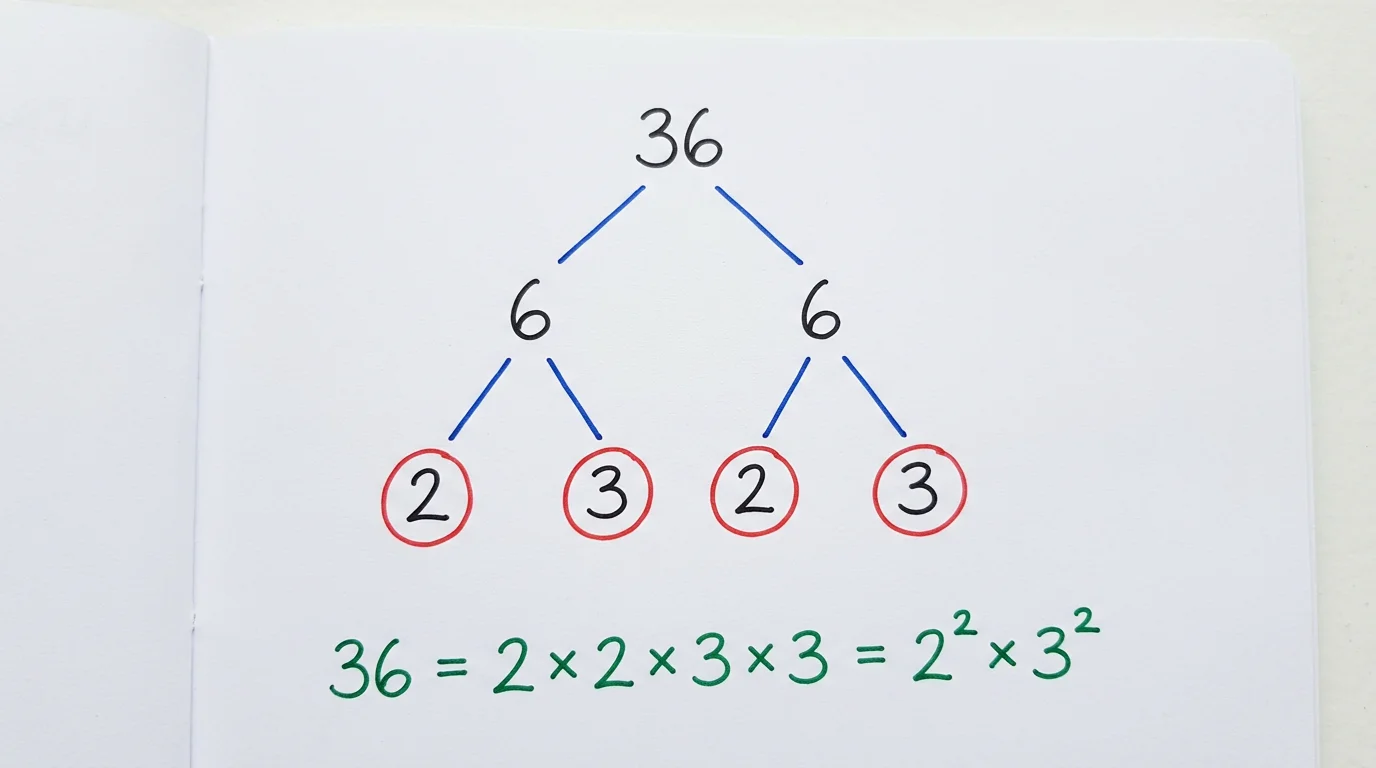
That gives 36 = 2 × 2 × 3 × 3 = 2² × 3². Notice both exponents are even. That is another way to spot a perfect square: when every exponent in the prime factorization is even, the number is a square, and 2² × 3² = (2 × 3)² = 6².
Check the count
Add 1 to each exponent and multiply: (2 + 1) × (2 + 1) = 9. It matches.
Is 36 Prime or Composite? Plus a Neat Fact
Composite, with nine factors that add up to 91. It also has a rare double life. Stack dots in a triangle with 8 rows (1 + 2 + 3 + … + 8) and you get 36, so it is a triangular number as well as a square. Very few numbers are both: 1, 36 and 1,225 are the first three.
Using the Factors of 36 to Simplify Fractions
A yard is 36 inches, so its factors show up in everyday measuring: half a yard is 18 inches, a third is 12, a quarter is 9 and a sixth is 6. For fractions, divide the top and bottom by a common factor:
- 18/36 = 1/2 (divide by 18)
- 12/36 = 1/3 (divide by 12)
- 24/36 = 2/3 (divide by 12, the GCF)
Common Factors of 36 With Other Numbers
Pair 36 with 48 and the shared factors are 1, 2, 3, 4, 6 and 12, so the GCF is 12. Pair it with 54 and the GCF jumps to 18. To find a GCF fast:
- Write the prime factorization of both numbers.
- Circle every prime they share.
- Multiply the shared primes, using the smaller power of each.