What Are the Factors of 23?
Suppose you have 23 stickers to share with friends. Two friends leaves 1 sticker over, three friends leaves 2, four friends leaves 3. Only one friend taking all 23, or 23 friends taking one each, comes out even. A factor is a whole number that divides another number exactly.
The factors of 23 are 1 and 23. Just two, so 23 is a prime number.
The Only Factor Pair of 23
When you look for pairs that multiply to 23, you find only one.
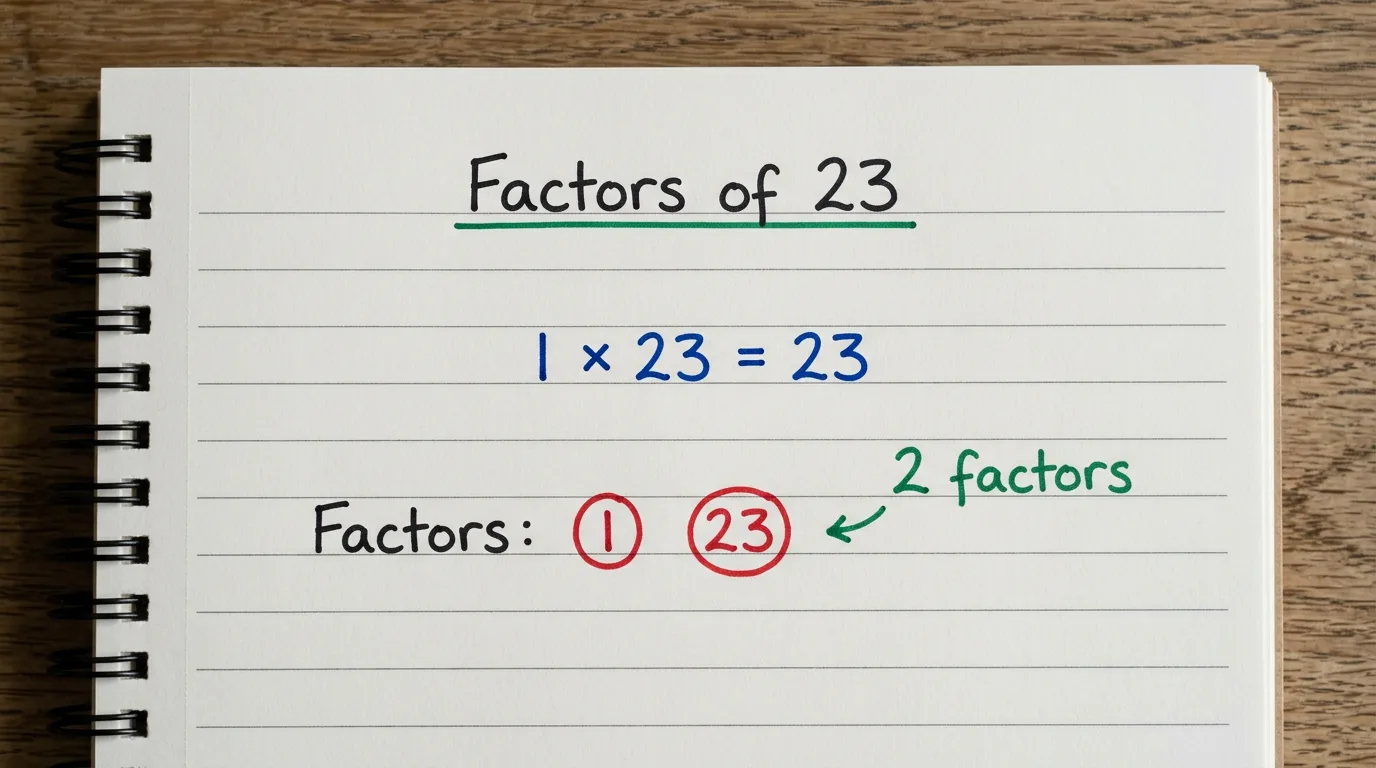
- Write 1 × 23 = 23.
- Search for another pair. There is none, so the list is 1 and 23.
How to Prove 23 Is Prime
You only test the primes up to the square root of 23, which is about 4.8. That leaves just 2 and 3 to check.
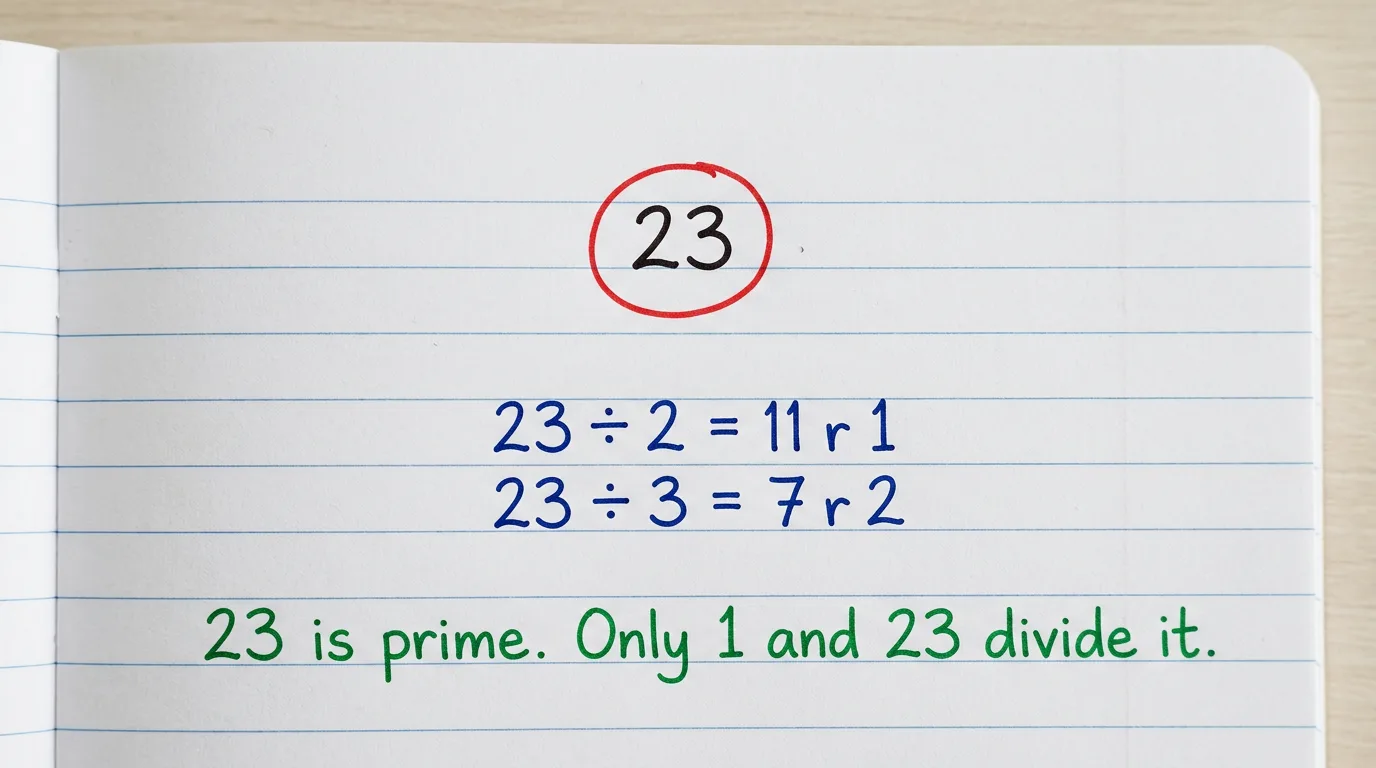
- 23 ÷ 2 = 11 with a remainder of 1, so 2 is not a factor.
- 23 ÷ 3 = 7 with a remainder of 2, so 3 is not a factor.
The prime factorization of 23 is just 23, so its factor tree is a single circled number.
Spotting primes quickly
An odd number that does not end in 5 and whose digits do not add to a multiple of 3 is worth testing. For 23 the digits add to 5, which is not a multiple of 3, and it is odd, which already knocks out 2 and 3.
Is 23 a Prime Number?
Yes. It is the ninth prime number, after 2, 3, 5, 7, 11, 13, 17 and 19. The sum of its factors is 1 + 23 = 24.
Real-Life Uses of 23
- Biology. Humans have 23 pairs of chromosomes.
- Time. A day has 24 hours, so hours on a 24-hour clock run from 0 to 23.
- Splitting groups. A group of 23 cannot form equal teams, so it always leaves someone out.
Common Factors of 23 With Other Numbers
Unless the other number is a multiple of 23, the only shared factor is 1, so the GCF is 1. For 23 and 46 the GCF is 23.
Quick Practice
Is 23 divisible by 3? No, since 23 ÷ 3 leaves 2. Is 69 divisible by 23? Yes, because 23 × 3 = 69. Check another number with the calculator.