What Are the Factors of 31?
A month with 31 days is awkward to split into equal weeks. Four weeks is 28 days and leaves 3, and five weeks is 35, which is too many. That is the hint that 31 has few factors. A factor is a whole number that divides another number exactly, with no remainder.
The factors of 31 are 1 and 31. Just two, so 31 is a prime number.
The Only Factor Pair of 31
Only one pair of numbers multiplies to 31.
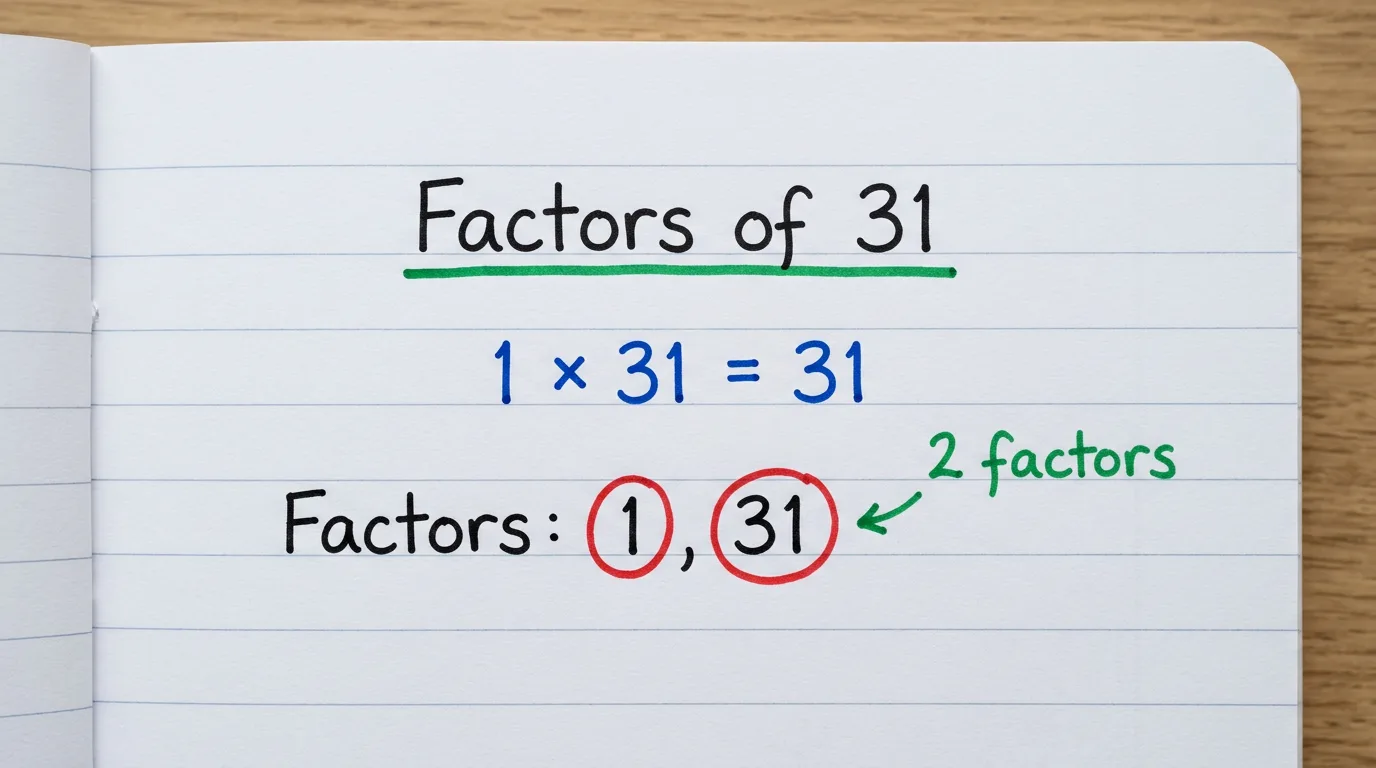
- Write 1 × 31 = 31.
- Look for another pair. There is none, so the list is 1 and 31.
How to Prove 31 Is Prime
Test only the primes up to the square root of 31, which is about 5.6. That means 2, 3 and 5.
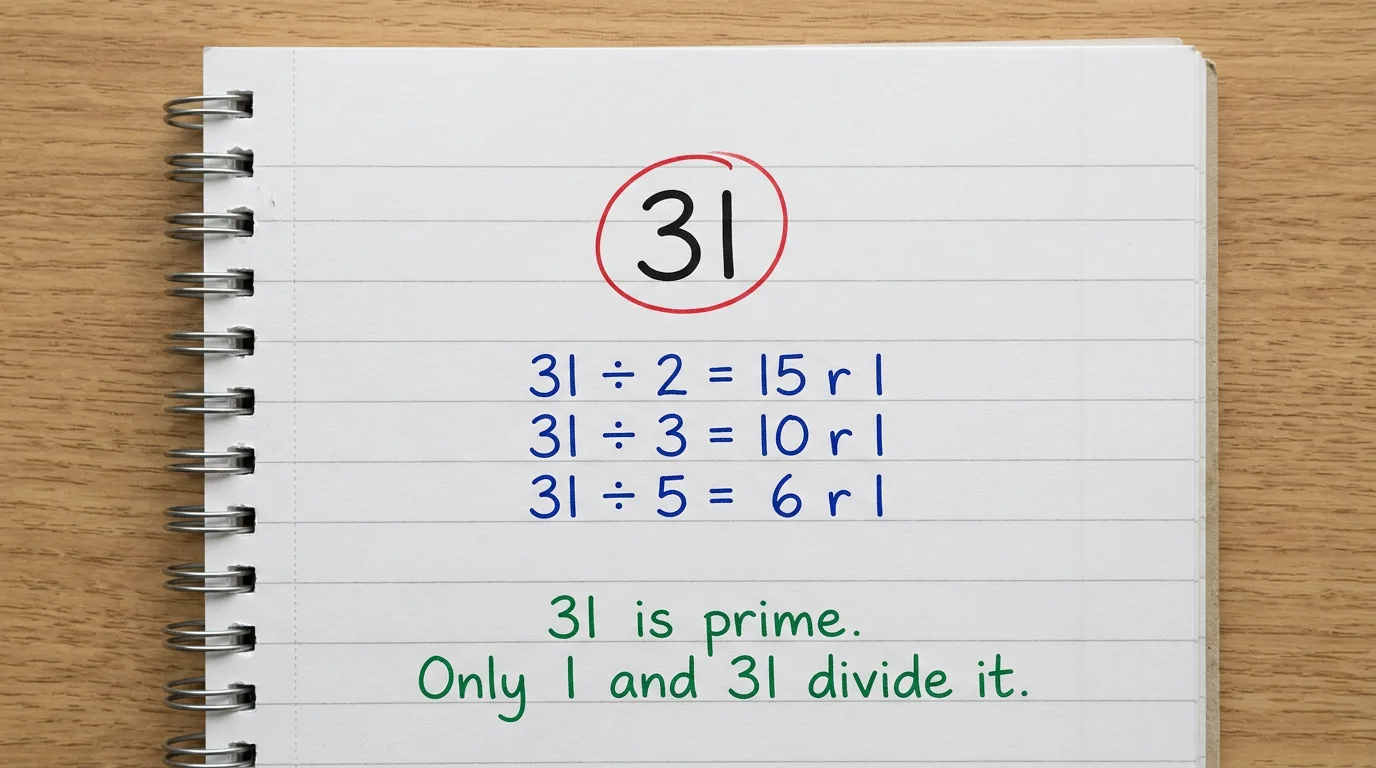
- 31 ÷ 2 = 15 with a remainder of 1, so 2 is not a factor.
- 31 ÷ 3 = 10 with a remainder of 1, so 3 is not a factor.
- 31 ÷ 5 = 6 with a remainder of 1, so 5 is not a factor.
The prime factorization of 31 is simply 31, so its factor tree is one circled number.
31 is a Mersenne prime
A Mersenne prime has the form 2ⁿ − 1. Here 2⁵ − 1 = 32 − 1 = 31, and the result is prime. These special primes are rare, and mathematicians use them to find the largest known primes.
Is 31 a Prime Number?
Yes. It is the eleventh prime number. The sum of its factors is 1 + 31 = 32.
Real-Life Uses of 31
- Calendars. January, March, May, July, August, October and December each have 31 days.
- Programming. The number 31 is a popular multiplier in hash functions because it is prime and fast to compute.
- Sharing. A group of 31 cannot be divided into equal teams.
Common Factors of 31 With Other Numbers
Unless the other number is a multiple of 31, the only shared factor is 1, so the GCF is 1. For 31 and 62 the GCF is 31.
Quick Practice
Is 31 divisible by 5? No, since 31 ÷ 5 leaves 1. Is 93 divisible by 31? Yes, because 31 × 3 = 93. Try another number with the calculator.