What Are the Factors of 60?
Ever wonder why an hour has 60 minutes and not 100? The answer is hiding in the factors. The factors of 60 are 1, 2, 3, 4, 5, 6, 10, 12, 15, 20, 30 and 60. That is twelve factors, which is a lot for such a small number, and it is exactly why the ancient Babylonians loved counting in sixties.
Factor Pairs of 60
Work through the numbers in order and write down each pair the moment a division comes out even. 60 is not a perfect square, so every factor gets its own partner.
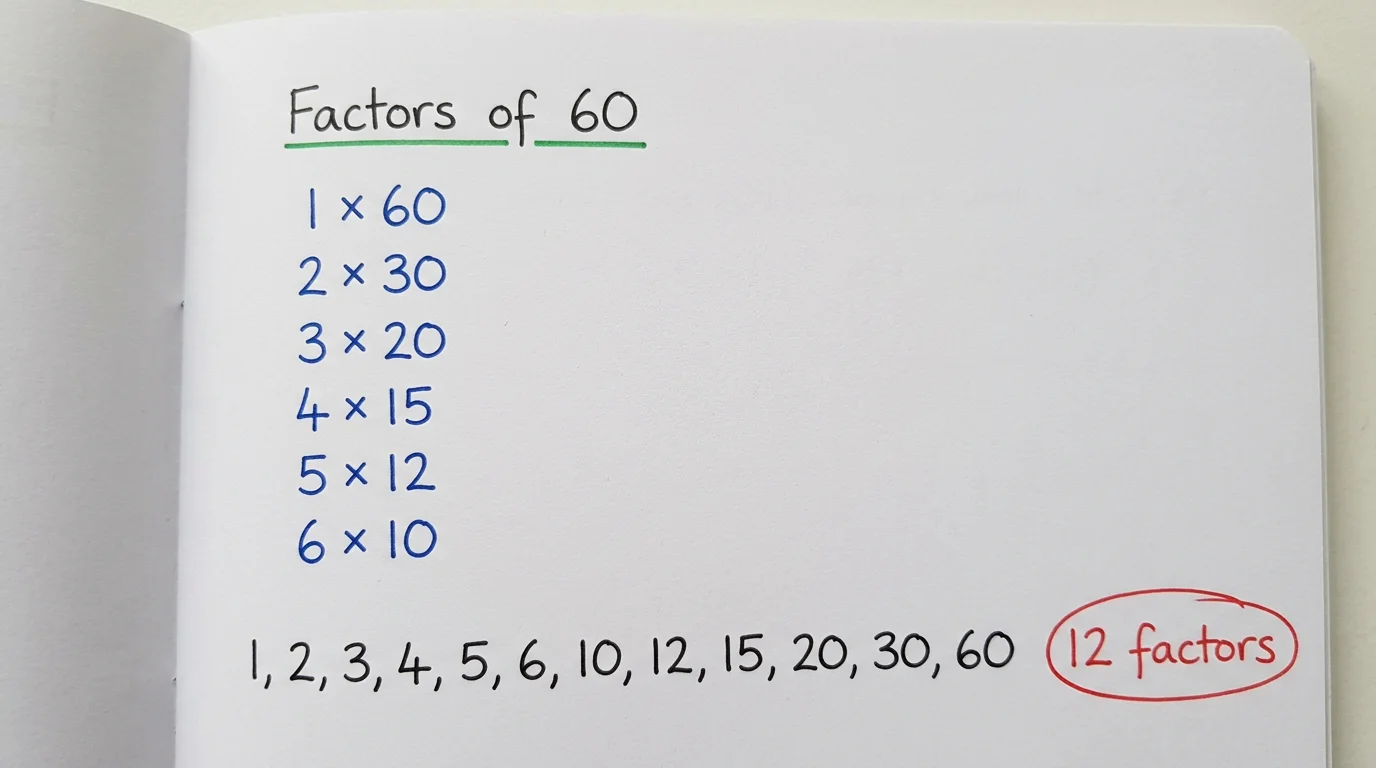
Notice that 7, 8 and 9 never appear. 60 ÷ 7, 60 ÷ 8 and 60 ÷ 9 all leave remainders, and once you pass 7 you are already past the square root of 60 (about 7.7), so you can safely stop.
Prime Factorization of 60 With a Factor Tree
A friendly way to start the tree is 6 × 10, because both numbers are easy to split again.
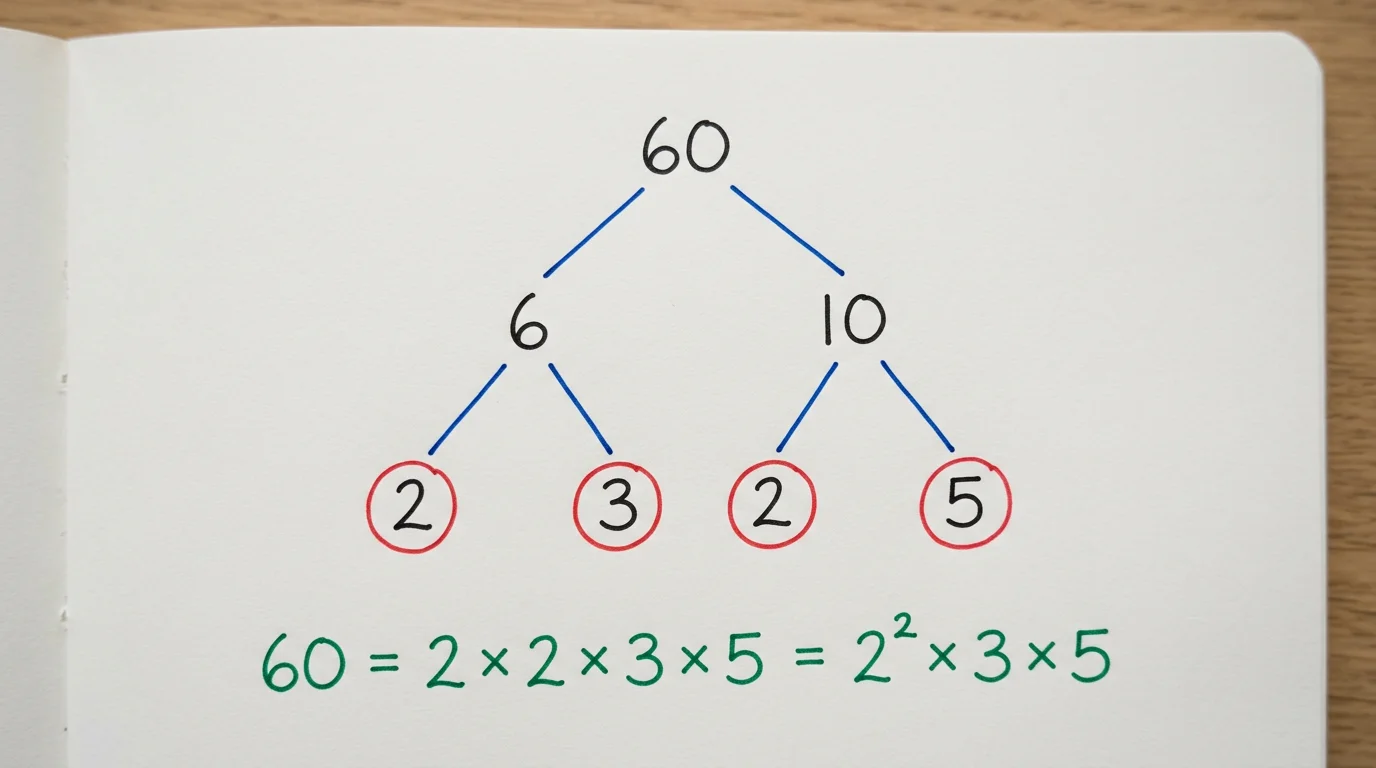
So 60 = 2 × 2 × 3 × 5 = 2² × 3 × 5. Its prime factors are 2, 3 and 5. Using the exponent trick, (2 + 1) × (1 + 1) × (1 + 1) = 12 factors, just as we listed.
Why 60 Is the Superstar of Divisibility
60 is divisible by every number from 1 to 6. In fact it is the smallest number that is. That means an hour splits into whole-minute pieces in more ways than almost any other choice:
- Half an hour = 30 minutes
- A third of an hour = 20 minutes
- A quarter of an hour = 15 minutes
- A fifth of an hour = 12 minutes
- A sixth of an hour = 10 minutes
Using 60 as a Common Denominator
Adding fractions needs matching bottoms, and 60 matches halves, thirds, fourths, fifths and sixths all at once. Try 1/2 + 1/3 + 1/5:
1/2 = 30/60, 1/3 = 20/60 and 1/5 = 12/60, so the total is 62/60, which simplifies to 31/30.
Is 60 Prime or Composite?
Composite. The proper factors (all except 60) add up to 108, which is bigger than 60, so it is an abundant number. Add all twelve factors and the sum is 168.
A Quick Divisibility Test for 60
Since 60 = 3 × 4 × 5, a number is divisible by 60 when it passes the tests for 3, 4 and 5. Try 840:
- It ends in 0, so it passes the test for 5.
- The last two digits, 40, divide by 4, so it passes for 4.
- The digits add up to 8 + 4 + 0 = 12, which divides by 3.
All three pass, so 840 is divisible by 60. Check: 60 × 14 = 840.
Common Factors of 60 With Other Numbers
GCF of 60 and 90
60 = 2² × 3 × 5 and 90 = 2 × 3² × 5. Take the smaller power of each shared prime: 2 × 3 × 5 = 30.
GCF of 60 and 72
72 = 2³ × 3², so the shared part is 2² × 3 = 12.