What Are the Factors of 144?
The factors of 144 are 1, 2, 3, 4, 6, 8, 9, 12, 16, 18, 24, 36, 48, 72 and 144. That is fifteen factors. A long list like this looks scary, but with the pairs method you can build it in a minute.
Factor Pairs of 144
Work down the numbers from 1. Whenever 144 divides evenly, write both numbers in a pair. Stop at 12, because 12 × 12 = 144.
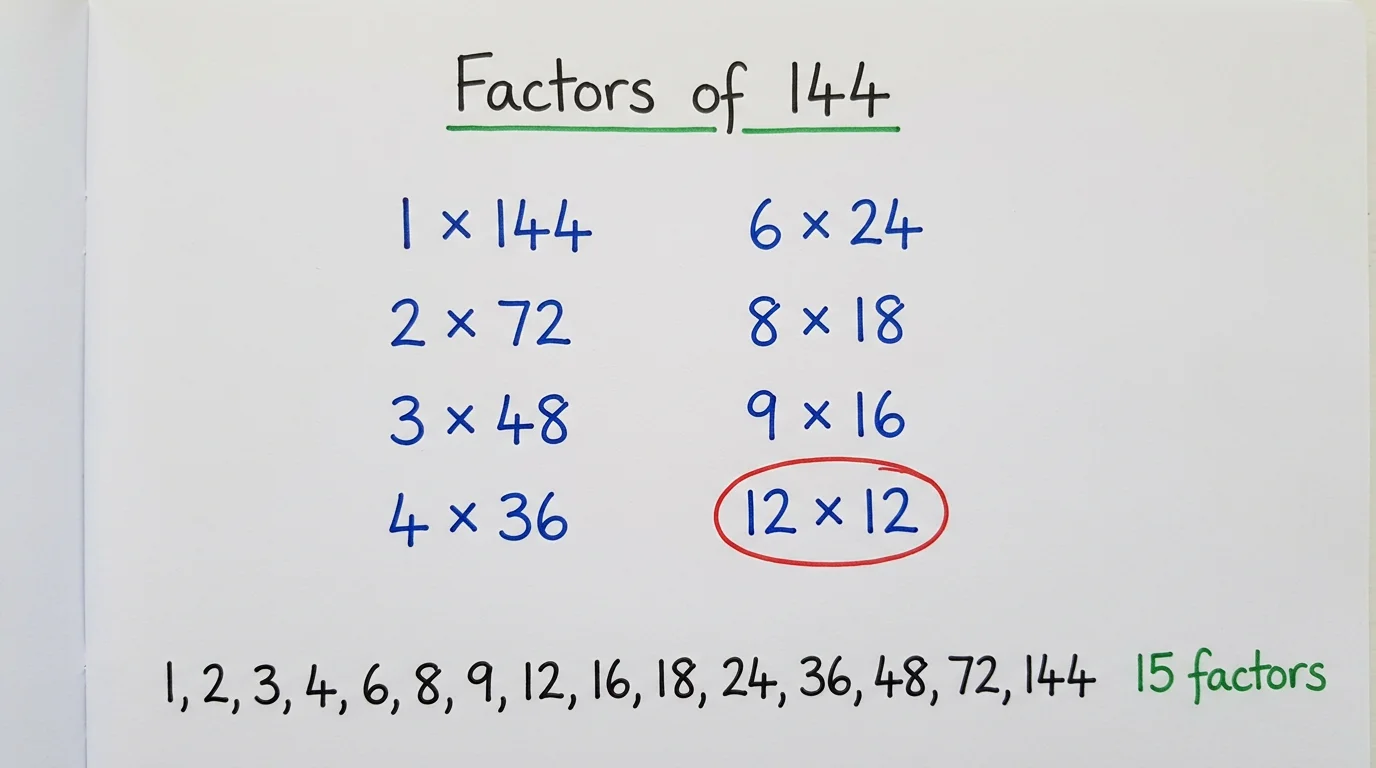
Seven full pairs give 14 factors, and the lonely 12 makes 15. Skip 5, 7, 10 and 11: none of them divide 144.
Prime Factorization of 144 With a Factor Tree
Because 144 = 12 × 12, start with two 12s. Each 12 splits into 3 × 4, and each 4 splits into 2 × 2.
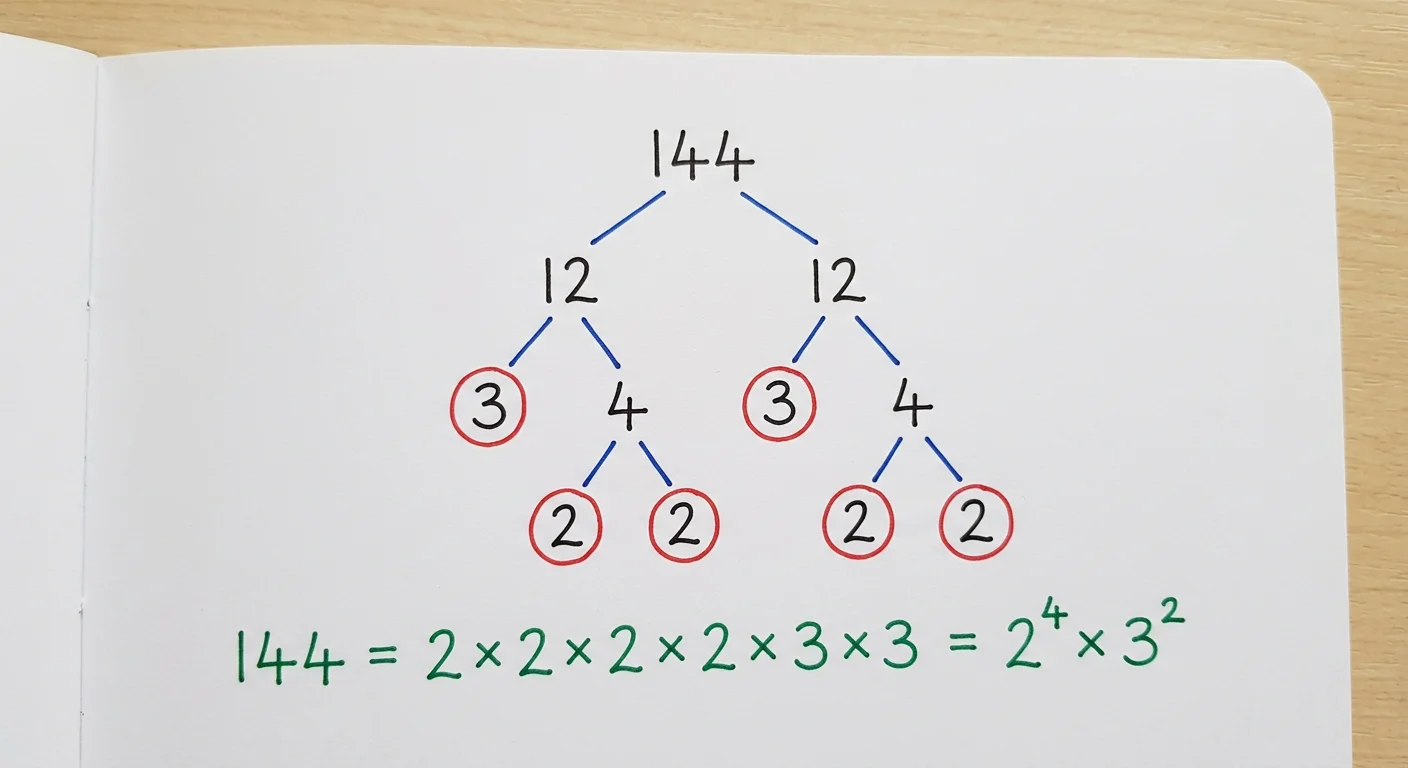
That gives 144 = 2⁴ × 3². Add 1 to each exponent: (4 + 1) × (2 + 1) = 15 factors. The sum of those factors comes from a similar shortcut: (1 + 2 + 4 + 8 + 16) × (1 + 3 + 9) = 31 × 13 = 403.
144 Is a Gross: A Dozen Dozens
12 × 12 = 144, so a gross is a dozen dozens. Shop owners used to order pencils, buttons and bolts by the gross. It also shows up in measuring: one square foot is 12 inches by 12 inches, which is 144 square inches.
Every factor pair is a rectangle with an area of 144. A 9 by 16 rectangle, an 8 by 18 rectangle and a 12 by 12 square all hold exactly the same amount of floor.
144 and the Fibonacci Sequence
Here is a fun one. The Fibonacci numbers start 1, 1, 2, 3, 5, 8, 13, 21, 34, 55, 89, 144, and each one is the sum of the two before it. 144 is the 12th term, and it is the only Fibonacci number above 1 that is also a perfect square.
Is 144 Prime or Composite?
Composite, and a perfect square. You only need to test numbers up to its square root, 12. That is why you never have to look at 13 or 17 when you build the list.
Common Factors of 144 With Other Numbers
- 144 and 96: 144 = 2⁴ × 3² and 96 = 2⁵ × 3, so the GCF is 2⁴ × 3 = 48.
- 144 and 180: 180 = 2² × 3² × 5, so the GCF is 2² × 3² = 36.
Simplify 96/144
- The GCF of 96 and 144 is 48.
- Divide the top: 96 ÷ 48 = 2.
- Divide the bottom: 144 ÷ 48 = 3.
So 96/144 simplifies to 2/3.