What Are the Factors of 360?
Draw a circle and you will meet 360 right away: a full turn is 360 degrees. That is no accident. The factors of 360 are 1, 2, 3, 4, 5, 6, 8, 9, 10, 12, 15, 18, 20, 24, 30, 36, 40, 45, 60, 72, 90, 120, 180 and 360, a whopping 24 of them.
Why Does a Circle Have 360 Degrees?
Nobody knows for sure, but the factors give a great reason. Because 360 has so many divisors, you can cut a circle into equal slices and every slice is a whole number of degrees:
- 2 slices = 180° each
- 3 slices = 120° each
- 4 slices = 90° each, a right angle
- 5 slices = 72° each
- 6 slices = 60° each
- 8, 9, 10 or 12 slices = 45°, 40°, 36° and 30°
A circle of 100 degrees could not be cut into thirds without decimals. 360 can, and that is exactly what a pizza chef, a clockmaker and a carpenter all need.
Factor Pairs of 360
360 is not a perfect square, so every factor has a different partner, and you get twelve pairs. That makes 12 × 2 = 24 factors, an even number.
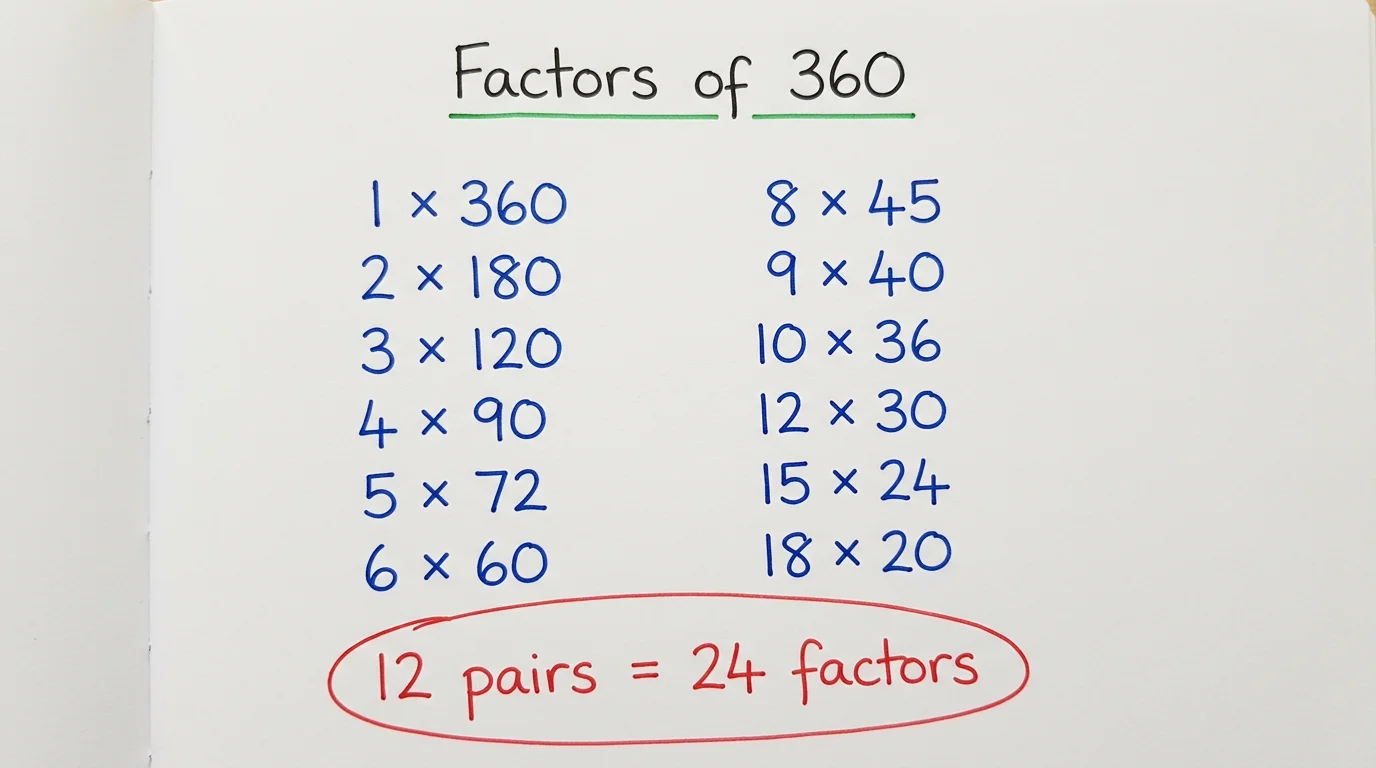
You can stop at 18, because the square root of 360 is a little under 19. Notice that 7 is missing, along with every multiple of 7. It is the only number from 1 to 10 that does not divide 360.
Prime Factorization of 360 With a Factor Tree
One easy route is 36 × 10. Then 36 becomes 6 × 6, and each 6 becomes 2 × 3, while 10 becomes 2 × 5.
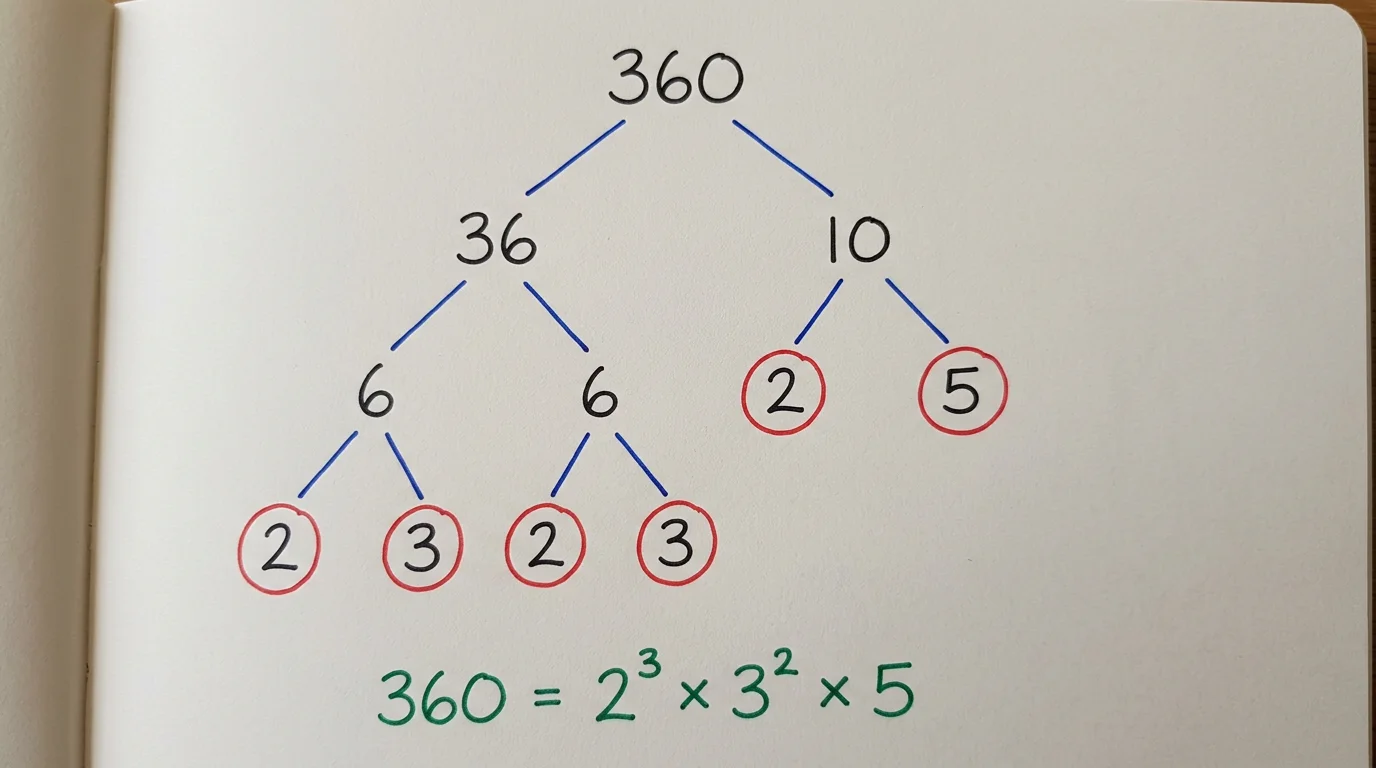
That gives 360 = 2³ × 3² × 5. Its prime factors are 2, 3 and 5.
Build All 24 Factors From the Prime Factorization
Here is a method that makes you feel like a wizard. Each factor of 360 picks some 2s, some 3s and some 5s:
- Powers of 2 to choose from: 1, 2, 4, 8 (4 choices)
- Powers of 3 to choose from: 1, 3, 9 (3 choices)
- Powers of 5 to choose from: 1, 5 (2 choices)
Mix one from each row and multiply. There are 4 × 3 × 2 = 24 combinations, one for every factor. For example, 8 × 9 × 5 = 360 and 2 × 3 × 5 = 30.
Is 360 Prime or Composite?
Composite, and a very rich one. Mathematicians call 360 a highly composite number because it has more factors than any smaller number. The sum of all 24 factors is (1 + 2 + 4 + 8) × (1 + 3 + 9) × (1 + 5) = 15 × 13 × 6 = 1,170.
Common Factors of 360 With Other Numbers
GCF of 360 and 240
240 = 2⁴ × 3 × 5, so the shared part is 2³ × 3 × 5 = 120. That simplifies 240/360 to 2/3.
GCF of 360 and 150
150 = 2 × 3 × 5², so the GCF is 2 × 3 × 5 = 30.
- Write both prime factorizations.
- Keep each shared prime with its smaller exponent.
- Multiply what is left.