What Are the Factors of 17?
Try dealing 17 cards into equal piles. Two piles leave a card over. Three piles leave two. Whatever you try, only 1 pile of 17 or 17 piles of 1 come out even. A factor is a whole number that divides another number exactly, and 17 has very few of them.
The factors of 17 are 1 and 17. Just two, which makes 17 a prime number.
The Only Factor Pair of 17
Hunting for pairs that multiply to 17 is a short job, because there is only one.
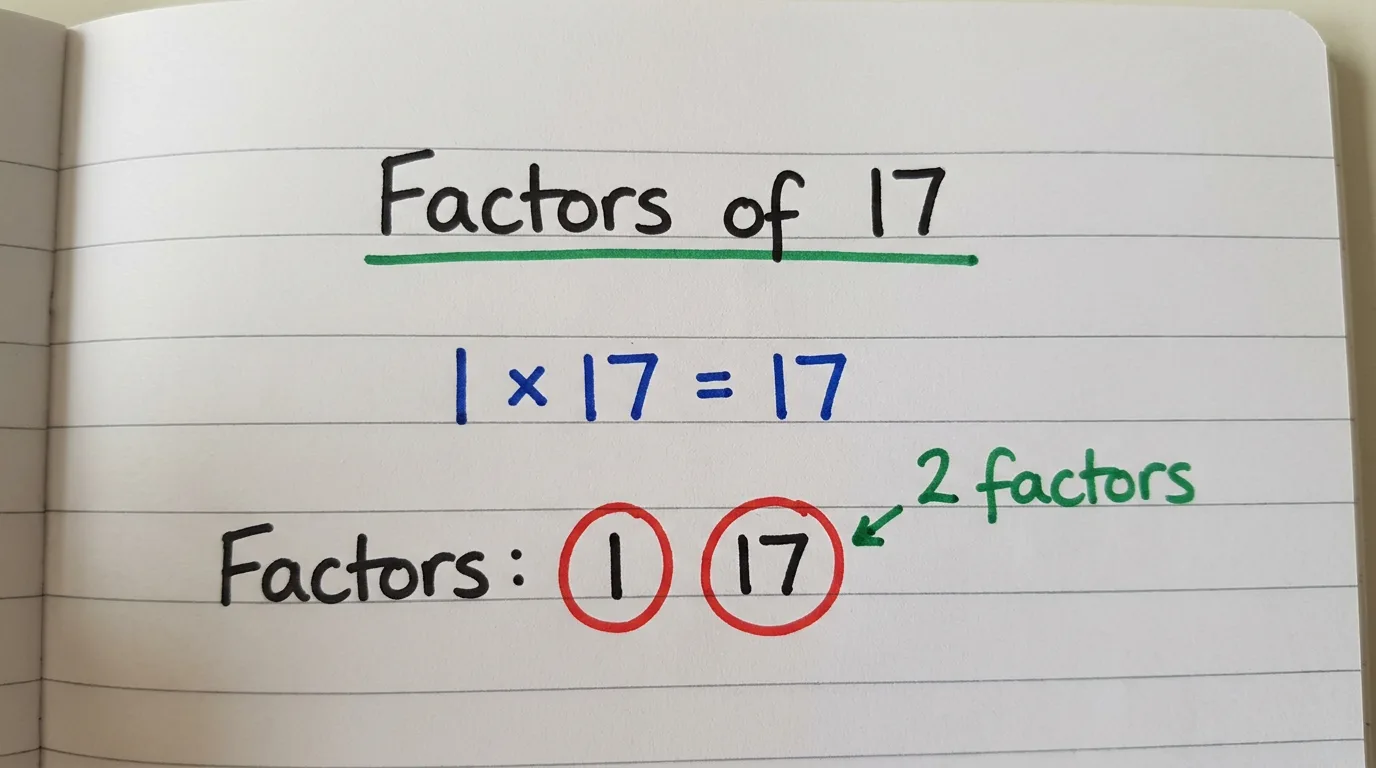
- Write 1 × 17 = 17.
- Look for another pair. None exists, so the list is just 1 and 17.
How to Prove 17 Is Prime
You only need to test primes up to the square root of 17, which is about 4.1. That means checking just 2 and 3.
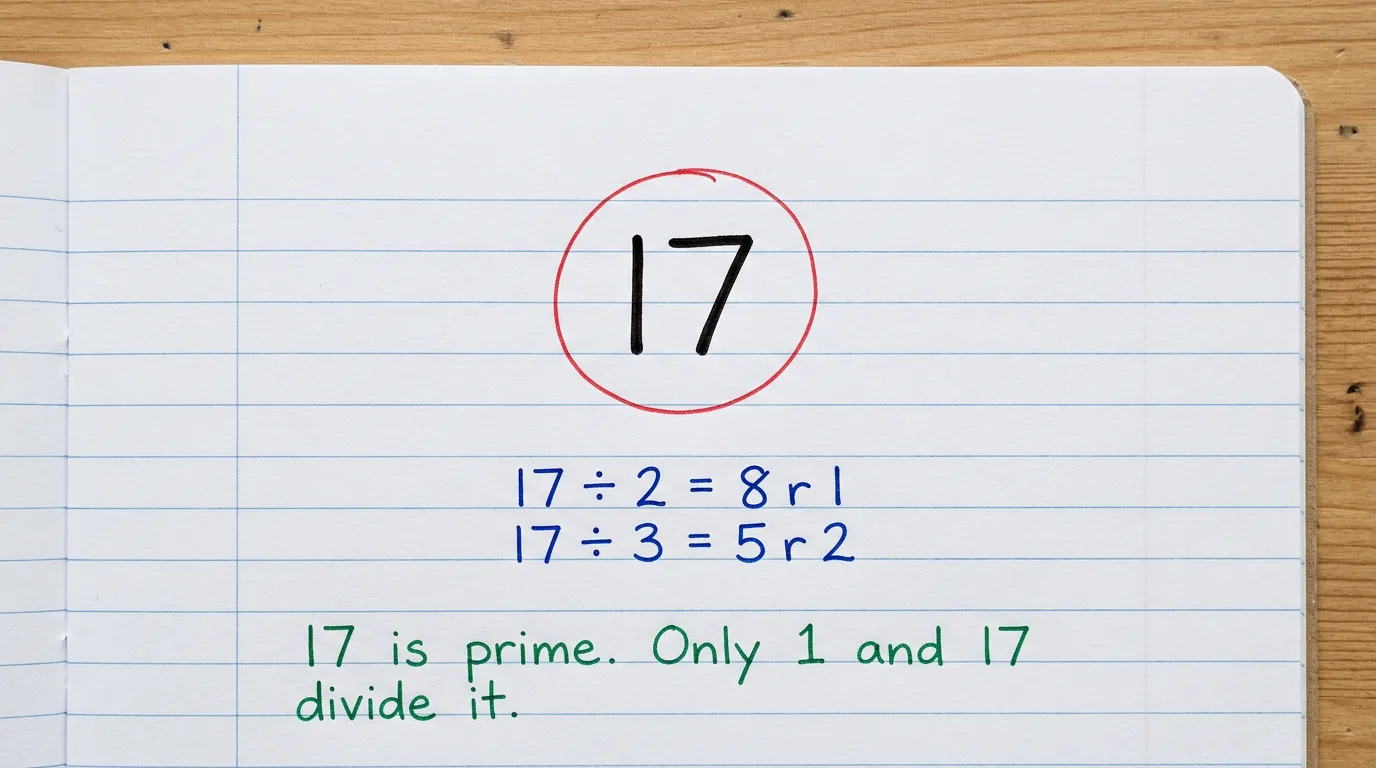
- 17 ÷ 2 = 8 with a remainder of 1, so 2 is not a factor.
- 17 ÷ 3 = 5 with a remainder of 2, so 3 is not a factor.
Nothing divides it, so the prime factorization of 17 is simply 17, with no branches in its factor tree.
Why you can stop at the square root
Factors come in pairs. If 17 had a factor bigger than 4.1, its partner would have to be smaller than 4.1, and you would have found that partner already. So there is no need to test further.
Is 17 a Prime Number?
Yes. It is the seventh prime number. The sum of its factors is 1 + 17 = 18.
Real-Life Uses of 17
- Cicadas. Some cicadas emerge every 17 years, and a prime cycle makes it hard for predators to sync up.
- Shifts and rotas. A group of 17 cannot be divided evenly, so it always needs one leftover person.
- Codes. Prime numbers like 17 are the building blocks of modern encryption.
Common Factors of 17 With Other Numbers
Unless the other number is a multiple of 17, the only shared factor is 1, so the GCF is 1. For 17 and 34 the GCF is 17.
Quick Practice
Is 17 divisible by 4? No, since 17 ÷ 4 leaves 1. Is 51 divisible by 17? Yes, because 17 × 3 = 51. Try another number with the calculator.