What Are the Factors of 30?
A month often has 30 days, which you can cut into 2 halves of 15, 3 blocks of 10 or 5 blocks of 6. Every one of those tidy splits is a factor: a whole number that divides another number exactly, with no remainder.
The factors of 30 are 1, 2, 3, 5, 6, 10, 15 and 30. That is eight factors.
Factor Pairs of 30
Look for pairs that multiply to 30, working from the outside in.
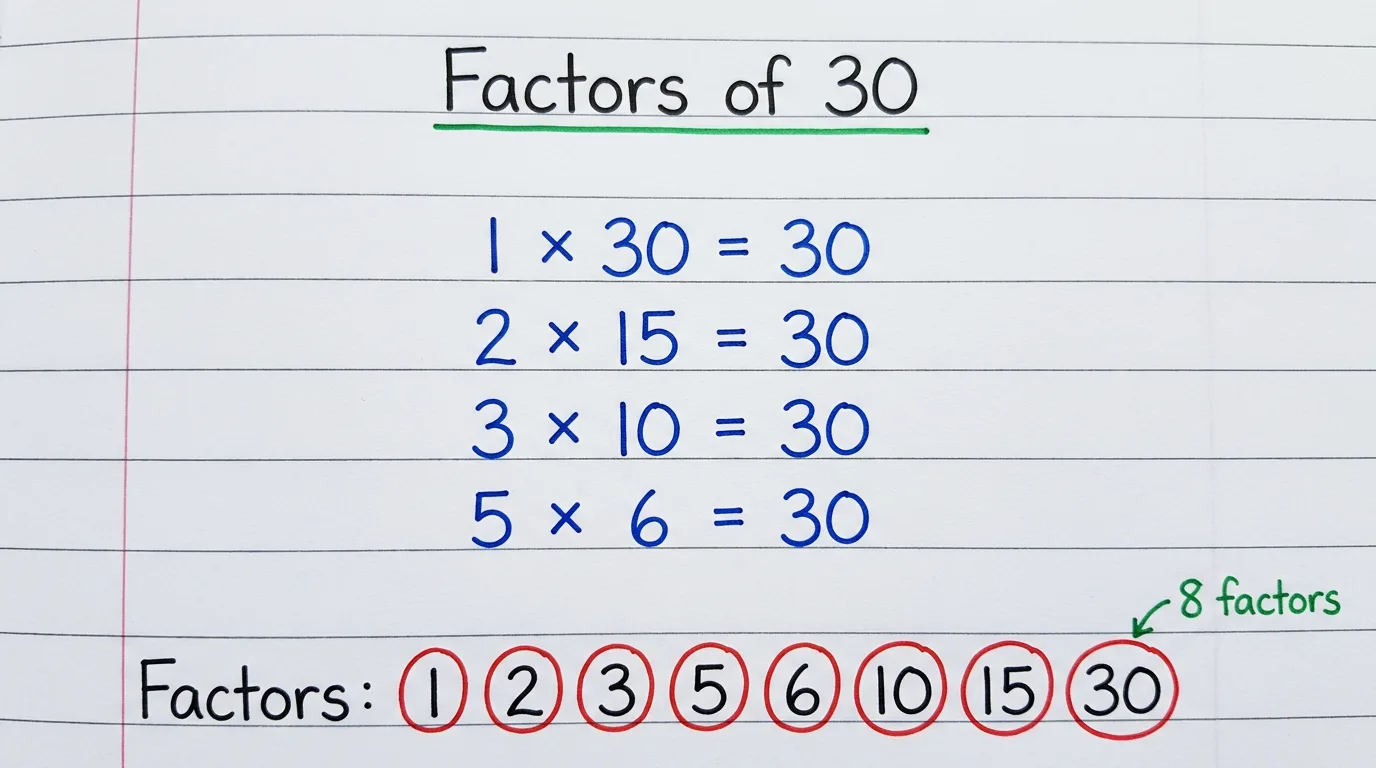
- Start with 1 × 30.
- Try 2. Since 30 ÷ 2 = 15, write 2 × 15.
- Try 3. Since 30 ÷ 3 = 10, write 3 × 10.
- Try 5. Since 30 ÷ 5 = 6, write 5 × 6.
- Keep trying whole numbers until you reach 6, which is already in your list. Every factor is now found, so you are done.
Prime Factorization of 30
Prime factors show what 30 is built from. Split it and keep going until every branch is a prime.
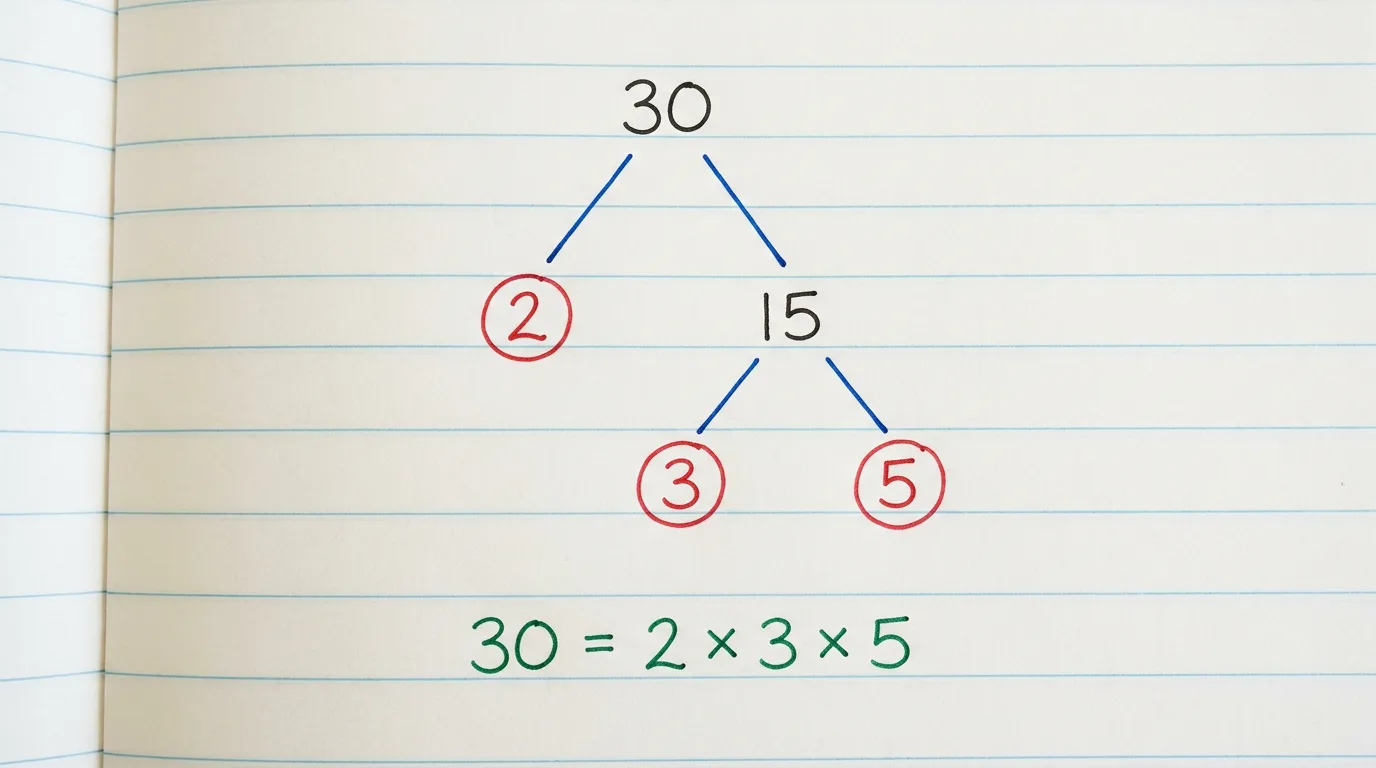
So 30 = 2 × 3 × 5. Its prime factors are 2, 3 and 5. Each prime appears once, so the count is (1 + 1) × (1 + 1) × (1 + 1) = 8, which matches the list.
Divisibility check for 30
A number divides by 30 when it divides by 2, 3 and 5. Take 270: it ends in 0 and its digits add up to 9, so 270 is a multiple of 30.
Is 30 a Prime or Composite Number?
Composite. It has eight factors. The sum of all factors is 1 + 2 + 3 + 5 + 6 + 10 + 15 + 30 = 72. The factors smaller than 30 add up to 42, which is more than 30, so 30 is called an abundant number.
Real-Life Uses of the Factors of 30
- Months. Thirty days split into halves of 15 or blocks of 10 and 6.
- Clocks. Thirty minutes is half an hour, and 30 is a factor of 60.
- Sharing. Thirty cards deal evenly to 2, 3, 5 or 6 players.
Common Factors of 30 With Other Numbers
The factors of 45 are 1, 3, 5, 9, 15 and 45, so 30 and 45 share 1, 3, 5 and 15. The GCF is 15, which simplifies 30/45 to 2/3.
Quick Practice
Which of these are factors of 30: 7, 5 or 9? Only 5. Now try 33 and check it with the calculator.